Can you feel the excitement? We are just 35 days away from the premier of Orrin Woodward and Oliver DeMille's "Call for American's to finally stand up and lead." That cry for freedom comes in a work of literary genius they have appropriately titled "LeaderShift."
What's causing all the buzz you might ask?
Well you might have noticed America is facing some troubled times. Hidden between the covers of this incredible work is a parable that addresses the issues we face in a manner that everyone can understand. It supplies us with an explanation of the "Five Laws of Decline" that have led to the demise of every great civilization since the dawn of time and how to address the erosion that currently threatens our freedom in a non-partisan, logical way.
Imagine if you will the innovation of thought when two minds of this caliber are melded into solution mode!
Oliver DeMille is a noted educator, personally mentored by the late, great Cleon Skousen. He's also a founder and previous president of George Wythe University. An incredible author in his own right, his works include...
Leadership Education
A Thomas Jefferson Education
The Student Whisperer
The Coming Aristocracy
The Four Lost American Ideals
1913
Freedom Shift
It's apparent by his body of work he's passionate about both education and freedom! His lectures strike a chord with attending audiences and move them with passion toward a clear and concise conclusion that a self directed education is mandatory to maintain our freedoms. His love and appreciation of the history that led to the founding of this great nation is communicated masterfully to those who are graced by his teachings. I've found Oliver's (and his wife Rachel) company one of the most impressionable experiences in my journey down the road of life.
As if this isn't powerful enough, consider the brain trust when this is added!
Orrin Woodward is a systems trained, recovering engineer, who graduated from Kettering University, holds four United States patents and an exclusive National Benchmarking Award for technical product analysis. His highly acclaimed blog (orrinwoodwardblog.com) has been awarded...
All Top Leadership Blog Selection...One of HR's Top 100 Blogs for Management and Leadership, and the International Association of Business Top 10 Leadership Sites.
Somehow he also manages to author books! Consider this body of work....
Co-wrote the NY Times, Wall Street Journal, USA Today, Business Weekly, and Money Magazine best seller Launching A Leadership Revolution
Authored- Resolved 13 Resolutions For Life, and has co-authored several more.
Do you think he has a passion for leadership?
Orrin's writing, video, audio, and speaking engagements are life changing teaching principles that have affected the lives of countless individuals and families. He's a voracious reader and a hungry student of history, leadership, and any topic related to the improvement of self. I can attest that his passion is directed in serving others and the restoration of this nation to the principled world leader it was designed to be. My daily interaction with Orrin (and his wife Laurie) has been both a blessing and an influence like no other.
So is your copy of LEADERSHIFT preordered?
Be the first one on your block to hold the solution to the leadership void our nation fights everyday in the palm of your hands!
God Bless!
Capt. Bill
Wednesday, March 13, 2013
Sunday, March 03, 2013
Orrin Woodward & Oliver DeMille: LeaderShift
Orrin Woodward and Oliver DeMille have launched a LeaderShift. Here is their announcement. Stay tuned for more details. LIFE is great for those who make it great. Are you ready to make a difference?

As the concepts developed, I imagined
discussing the Five Laws of Decline with the Founding Fathers and
determining how they would have designed the Constitution had they
understood the inherent dangers within the laws. Accordingly, I wrote
out a proposed government to check the FLD and separate government into
clearly delineated local, state, and federal issues. In my opinion, the
number one failure of the founder was not to place a specific limit on
taxation and deficits. If government is not limited in their ability to
tax then it simply isn’t a limited government. Likewise, if politicians
are not held responsible for a budget, then they are not responsible at
all. Moreover, relying on “the people” to maintain intricate knowledge
of all the issues simply isn’t feasible and is statements like this are
pollyanna at best and hypocrisy at worst.
The local government would be responsible for all local issues and receive a set percentage of local taxpayers income, the state would receive a percent of the the state taxpayer incomes, and the federal would receive a percent from every citizen in the country. With no deductions or special deals, just a straight flat tax to fund government and the rest is kept by the hardworking Americans who earned it. Imagine localities having town meetings where local leaders meet and discuss local issues. This principle is called “expect and inspect.” Leaders must expect the best from their people, but unless they inspect the results, they will be let down. This, in a nutshell, is one of the biggest issues in our government today. We have expected too much from our politicians, but centralized everything to Washington and few citizens have the time or understanding to inspect properly.
However, local issues and local town meetings would change this greatly. It’s time to get local leaders active in local issues again. The town meetings were the American way during our formative period. In reality, no person alive is capable of running a country and a budget the size of America. The Federal government ought to be responsible for the defense of our country from internal and external foes and adjudication of disputes between states, corporations, etc. The States can ensure Federal government doesn’t extend beyond its responsibilities and address state issues with localities while the localities handle all the remaining issues at the local level. With each level checking the level above it, which ensures the expecting and inspecting process is in working order, we can hold politicians responsible for the results. Indeed, since this is what each household must do (stay within a budget, pay it bills, and fulfill its duties), why can’t our politicians handle these leadership task? In other words, does anyone else find it peculiar that we have a lower bar for our political leaders than we do our family leaders when, in truth, we ought to hold the political leaders to a higher standard?
With these concepts in hand, I sat down with Oliver DeMille, my good friend and one of the best students of the American Founders in America today. Oliver, in short, is a polymathic genius and we spent a full day in discussion on this proposal and how to communicate it to the world. After comprehending the FLD and the proposal, Oliver improved upon it and started writing a fable that captured the key principles in an entertaining way. I was blown away by the storyline and drama contained in this short (under 150 pages) book and after several revisions we knew LeaderShift was something special. Excitedly, I sent it on to Rick Wolff, the General Editor for Business Plus, and he loved it as well. Rick, one of the best editors in the industry, has turbo-charged this book through the publishing process. In fact, from meeting with Oliver to the release date is less than one year – a practically unheard of feat in publishing profession! Moreover, Business Plus is one of the most respected names (with over 50 bestsellers) in the field, publishing books by Hank Paulson, Jack Welch, Coach K, and many more. Oliver and I are honored to be included in this elite group.
Shortly before his death, historian Thomas Macaulay wrote to a friend in America, “Your republic will be fearfully plundered and laid waste by barbarians in the twentieth century as the Roman Empire was in the fifth, with this difference: that the Huns and Vandals will have been engendered within your own country by your own institutions.” This can and must be halted in 2013 through a LeaderShift! Arnold Toynbee, the great historian, studied every historical civilization. He believed that in the final hours before every civilization’s collapse, that leaders would emerge with proposals, that, if heeded, could halt the decline and bring much needed revitalization. It is my humble opinion that LeaderShift is such a proposal and can turnaround our country if enough people are willing to lead at the local level! America’s turnaround can be a beacon of hope and light for the remnants of liberty remaining within Western Civilization.
On April 16th, LeaderShift will be available on Amazon, Barnes & Nobles and bookstores across North America. I have never been more excited for the start of a new year than I am for 2013. I believe a turning point in the history of freedom is upon us and I plan on playing my part. Will you do the same? Oliver and I will be traveling around North America on a book signing tour on the release of the book so stay tuned for dates and locations near you. Here is an interview discussing the book and acclamations from early reviewers.
Sincerely,
Orrin Woodward
LeaderShift: Orrin Woodward and Oliver DeMille
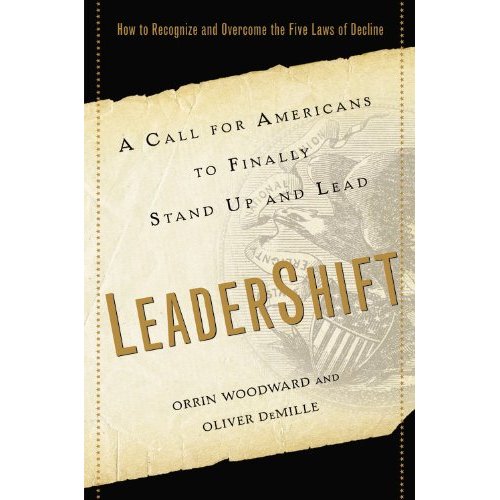
LeaderShift by Orrin Woodward and Oliver DeMille
The local government would be responsible for all local issues and receive a set percentage of local taxpayers income, the state would receive a percent of the the state taxpayer incomes, and the federal would receive a percent from every citizen in the country. With no deductions or special deals, just a straight flat tax to fund government and the rest is kept by the hardworking Americans who earned it. Imagine localities having town meetings where local leaders meet and discuss local issues. This principle is called “expect and inspect.” Leaders must expect the best from their people, but unless they inspect the results, they will be let down. This, in a nutshell, is one of the biggest issues in our government today. We have expected too much from our politicians, but centralized everything to Washington and few citizens have the time or understanding to inspect properly.
However, local issues and local town meetings would change this greatly. It’s time to get local leaders active in local issues again. The town meetings were the American way during our formative period. In reality, no person alive is capable of running a country and a budget the size of America. The Federal government ought to be responsible for the defense of our country from internal and external foes and adjudication of disputes between states, corporations, etc. The States can ensure Federal government doesn’t extend beyond its responsibilities and address state issues with localities while the localities handle all the remaining issues at the local level. With each level checking the level above it, which ensures the expecting and inspecting process is in working order, we can hold politicians responsible for the results. Indeed, since this is what each household must do (stay within a budget, pay it bills, and fulfill its duties), why can’t our politicians handle these leadership task? In other words, does anyone else find it peculiar that we have a lower bar for our political leaders than we do our family leaders when, in truth, we ought to hold the political leaders to a higher standard?
With these concepts in hand, I sat down with Oliver DeMille, my good friend and one of the best students of the American Founders in America today. Oliver, in short, is a polymathic genius and we spent a full day in discussion on this proposal and how to communicate it to the world. After comprehending the FLD and the proposal, Oliver improved upon it and started writing a fable that captured the key principles in an entertaining way. I was blown away by the storyline and drama contained in this short (under 150 pages) book and after several revisions we knew LeaderShift was something special. Excitedly, I sent it on to Rick Wolff, the General Editor for Business Plus, and he loved it as well. Rick, one of the best editors in the industry, has turbo-charged this book through the publishing process. In fact, from meeting with Oliver to the release date is less than one year – a practically unheard of feat in publishing profession! Moreover, Business Plus is one of the most respected names (with over 50 bestsellers) in the field, publishing books by Hank Paulson, Jack Welch, Coach K, and many more. Oliver and I are honored to be included in this elite group.
Shortly before his death, historian Thomas Macaulay wrote to a friend in America, “Your republic will be fearfully plundered and laid waste by barbarians in the twentieth century as the Roman Empire was in the fifth, with this difference: that the Huns and Vandals will have been engendered within your own country by your own institutions.” This can and must be halted in 2013 through a LeaderShift! Arnold Toynbee, the great historian, studied every historical civilization. He believed that in the final hours before every civilization’s collapse, that leaders would emerge with proposals, that, if heeded, could halt the decline and bring much needed revitalization. It is my humble opinion that LeaderShift is such a proposal and can turnaround our country if enough people are willing to lead at the local level! America’s turnaround can be a beacon of hope and light for the remnants of liberty remaining within Western Civilization.
On April 16th, LeaderShift will be available on Amazon, Barnes & Nobles and bookstores across North America. I have never been more excited for the start of a new year than I am for 2013. I believe a turning point in the history of freedom is upon us and I plan on playing my part. Will you do the same? Oliver and I will be traveling around North America on a book signing tour on the release of the book so stay tuned for dates and locations near you. Here is an interview discussing the book and acclamations from early reviewers.
Sincerely,
Orrin Woodward

Wednesday, January 23, 2013
Sour Grapes!
Another blast fom the past by Orrin Woodward. I love that the message never changes as we travel down the road of LIFE. Enjoy!
God Bless!
Capt. Bill
Many years ago Solomon stated in Ecclesiastes, “There is nothing new under the sun.” This statement is as true today as the day he wrote it. Yes, we have new technological inventions, but human nature hasn’t changed in the least; therefore, the underlying principles haven’t changed either. Aesop Fables is a collection of short animal stories that teach these timeless truths about people. Here is one of my favorites:
ONE hot summer’s day a Fox was strolling through an orchard till he came to a bunch of Grapes just ripening on a vine which had been trained over a lofty branch. “Just the things to quench my thirst,” quoth he. Drawing back a few paces, he took a run and a jump, and just missed the bunch. Turning round again with a One, Two, Three, he jumped up, but with no greater success. Again and again he tried after the tempting morsel, but at last had to give it up, and walked away with his nose in the air, saying: “I am sure they are sour.”
MORAL: “IT IS EASY TO DESPISE WHAT YOU CANNOT GET”
In the business building arena, the moral is changed slightly to read:
“It’s easy to despise the business that you cannot build.”
When leaders are exposed to their own weaknesses, shortcomings, and incompetencies, they will quickly confront reality and change. However, when non-leaders are exposed to the similar circumstances, they will run to rationalizations, suffering from “sour grapes” syndrome. Since Sturgeon’s Law applies to business, sports, and the arts, why should anyone be shocked the 90% of the people in business are in need of further change in order to produce results? They can achieve victory, but only if they are willing to grow personally. This revelation leaves people with only two choices: change or blame. It’s a sad indictment on our culture today that so many choose to blame rather than to change.
YOU make your own bed in life, but you must also sleep in it. I am proud of the ten-plus new RT’s that we will be recognized in Columbus; they have chosen the leadership path of changing and growing. I love free enterprise because if a person has a better plan and executes it properly then his results cannot be hidden for long. On the other hand, if he is just talking “sour grapes,” his poison ultimately boomerangs upon himself, destroying the love, grace, and thankfulness needed to bounce back. So no matter what else you do, be careful of your thoughts. For your thoughts today eventually become your life tomorrow. Forgive others quickly and sincerely and move on for everyone’s sake. This is the only way to overcome bitterness and resentment – drinking poison so that others may die.
I have failed at many things, but I refuse to blame others for them. In fact, in my opinion, it’s only when you blame others for your life’s defeats that you descend from suffering a loss into becoming a loser. Regardless of what must be confronted, no short-term pain-avoiding blame-game maneuvering is worth that price. YOU deserve to win and the price for victory is accepting responsibility.
Sincerely,
Orrin Woodward
God Bless!
Capt. Bill
Many years ago Solomon stated in Ecclesiastes, “There is nothing new under the sun.” This statement is as true today as the day he wrote it. Yes, we have new technological inventions, but human nature hasn’t changed in the least; therefore, the underlying principles haven’t changed either. Aesop Fables is a collection of short animal stories that teach these timeless truths about people. Here is one of my favorites:
ONE hot summer’s day a Fox was strolling through an orchard till he came to a bunch of Grapes just ripening on a vine which had been trained over a lofty branch. “Just the things to quench my thirst,” quoth he. Drawing back a few paces, he took a run and a jump, and just missed the bunch. Turning round again with a One, Two, Three, he jumped up, but with no greater success. Again and again he tried after the tempting morsel, but at last had to give it up, and walked away with his nose in the air, saying: “I am sure they are sour.”
MORAL: “IT IS EASY TO DESPISE WHAT YOU CANNOT GET”
In the business building arena, the moral is changed slightly to read:
“It’s easy to despise the business that you cannot build.”
When leaders are exposed to their own weaknesses, shortcomings, and incompetencies, they will quickly confront reality and change. However, when non-leaders are exposed to the similar circumstances, they will run to rationalizations, suffering from “sour grapes” syndrome. Since Sturgeon’s Law applies to business, sports, and the arts, why should anyone be shocked the 90% of the people in business are in need of further change in order to produce results? They can achieve victory, but only if they are willing to grow personally. This revelation leaves people with only two choices: change or blame. It’s a sad indictment on our culture today that so many choose to blame rather than to change.
YOU make your own bed in life, but you must also sleep in it. I am proud of the ten-plus new RT’s that we will be recognized in Columbus; they have chosen the leadership path of changing and growing. I love free enterprise because if a person has a better plan and executes it properly then his results cannot be hidden for long. On the other hand, if he is just talking “sour grapes,” his poison ultimately boomerangs upon himself, destroying the love, grace, and thankfulness needed to bounce back. So no matter what else you do, be careful of your thoughts. For your thoughts today eventually become your life tomorrow. Forgive others quickly and sincerely and move on for everyone’s sake. This is the only way to overcome bitterness and resentment – drinking poison so that others may die.
I have failed at many things, but I refuse to blame others for them. In fact, in my opinion, it’s only when you blame others for your life’s defeats that you descend from suffering a loss into becoming a loser. Regardless of what must be confronted, no short-term pain-avoiding blame-game maneuvering is worth that price. YOU deserve to win and the price for victory is accepting responsibility.
Sincerely,
Orrin Woodward
Wednesday, August 29, 2012
Leading The Pack!
Here's an Orrin Woodward classic I dug up from the archives. I love how years later principles never ever change! It's short but sweet and still appropriate!
God Bless!
Capt. Bill
Leading The Pack!
Leaders stay a little more progressive.
They do so by:
Being a little more innovative. A little more creative.
By taking that extra step.
Spending a little more effort.
Getting a little more accomplished.
Getting a few more results.
However, leaders can't run too far ahead of the pack without bringing others with them. They need support from others to be successful themselves. Leaders stay ahead but make sure others are with them.
It is a mistake to look too far ahead. Only one link in the chain of destiny can be handled at a time.
Winston Churchill
God Bless!
Capt. Bill
Leading The Pack!
Leaders stay a little more progressive.
They do so by:
Being a little more innovative. A little more creative.
By taking that extra step.
Spending a little more effort.
Getting a little more accomplished.
Getting a few more results.
However, leaders can't run too far ahead of the pack without bringing others with them. They need support from others to be successful themselves. Leaders stay ahead but make sure others are with them.
It is a mistake to look too far ahead. Only one link in the chain of destiny can be handled at a time.
Winston Churchill
Monday, June 18, 2012
Leaders Are LIFE-Time Learners!
You have to love the concept of compensated communities! Every community has leadership, and to be one of those leaders you have to have something to offer those you intend to lead. Below is a great Orrin Woodward post on just that topic!
God Bless!
Capt. Bill
Every leader must be a learner. Why? Because no leader has all the answers. Therefore, a leader must constantly be learning to improve and grow. In fact, if a person refuses to learn, he has effectively limited his ability to lead. This is the reason hunger is so essential for leadership because only a hungry person will keep striving to learn more.
Are you a hungry leader? Are you humble enough to know that you don’t know everything? Are you willing to read, listen, and associate with other leaders in a community in order to improve yourself? The LIFE community is what makes LIFE’s leadership better than any other leadership company. LIFE’s leadership materials supply people with topnotch leadership teachings, but even more importantly, it’s the LIFE community that provides the environment in which to apply the leadership principles daily.
LIFE, by having a compensated community, has a competitive advantage on the rest of the leadership companies. Here are some sites by other founders of LIFE that every member should visit. Click on the name for direct access!
Claude Hamilton
Dan Hawkins
Tim Marks
Sincerely,
Orrin Woodward
Monday, April 30, 2012
Life With Orrin Woodward!
You have to love this concept! Who doesn't want to improve in every area of their life? Join us in the 90 day Mental Fitness Challenge!
God Bless!
Capt. Bill
It is here – The Mental Fitness Challenge! The official release of the best systematically designed personal development program ever. I teamed up with NY Times best-selling author Chris Brady to conceptualize and develop a step-by-step process to grow personally from the inside out starting with private achievements, moving onto public achievements, then to leadership achievements, and eventually culminating in a legacy achievement. Anyone reading this who has the mind, heart, and desire to change can now achieve his or her destiny.
The Mental Fitness Challenge is based around my book RESOLVED: 13 Resolutions for LIFE. Each of the resolutions is focused on for one week, leading to a 13-week program designed to inculcate the 13 resolutions mindset into your life. I have never been happier with a personal development product, and I am excited to play a part in helping people fulfill their purposes. What is the life you have always wanted? Isn’t it time to pursue it today?
Sincerely,
Orrin Woodward
God Bless!
Capt. Bill
It is here – The Mental Fitness Challenge! The official release of the best systematically designed personal development program ever. I teamed up with NY Times best-selling author Chris Brady to conceptualize and develop a step-by-step process to grow personally from the inside out starting with private achievements, moving onto public achievements, then to leadership achievements, and eventually culminating in a legacy achievement. Anyone reading this who has the mind, heart, and desire to change can now achieve his or her destiny.
The Mental Fitness Challenge is based around my book RESOLVED: 13 Resolutions for LIFE. Each of the resolutions is focused on for one week, leading to a 13-week program designed to inculcate the 13 resolutions mindset into your life. I have never been happier with a personal development product, and I am excited to play a part in helping people fulfill their purposes. What is the life you have always wanted? Isn’t it time to pursue it today?
Sincerely,
Orrin Woodward
Thursday, April 05, 2012
Information!
One of the many things I admire about Orrin Woodward is his ability to sniff out information us average humanoids just don't have the time or will to find. Take advantage of this great information Orrin has taken the time to share with us!
God Bless!
Capt. Bill
Strength of will and tact are not necessarily, perhaps not generally, conjoined, and often the first seems somewhat to impair the second. The strong passion, the intense conviction, the commanding and imperious nature overriding obstacles and defying opposition, that often goes with a will of abnormal strength, does not naturally harmonize with the reticence of expression, the delicacy of touch and management that characterize a man who possesses in a high degree the gift of tact. There are circumstances and times when each of these two things is more important than the other, and the success of each man will mainly depend upon the suitability of his peculiar gift to the work he has to do.
‘The daring pilot in extremity’ is often by no means the best navigator in a quiet sea; and men who have shown themselves supremely great in moments of crisis and appalling danger, who have built up mighty nations, subdued savage tribes, guided the bark of the State with skill and courage amid the storms of revolution or civil war, and written their names in indelible letters on the page of history, have sometimes proved far less successful than men of inferior powers in the art of managing assemblies, satisfying rival interests or assuaging by judicious compromise old hatreds and prejudices. We have had at least one conspicuous example of the difference of these two types in our own day in the life of the great founder of German Unity.
Sometimes, however, men of great strength of will and purpose possess also in a high degree the gift of tact; and when this is combined with soundness of judgment it usually leads to a success in life out of all proportion to their purely intellectual qualities. In nearly all administrative posts, in all the many fields of labour where the task of man is to govern, manage, or influence others, to adjust or harmonize antagonisms of race or interests or prejudices, to carry through difficult business without friction and by skillful co-operation, this combination of gifts is supremely valuable. It is much more valuable than brilliancy, eloquence, or originality. I remember the comment of a good judge of men on the administration of a great governor who was pre-eminently remarkable for this combination. ‘ He always seemed to gain his point, yet he never appeared to be in antagonism with anyone.’ The steady pressure of a firm and consistent will was scarcely felt when it was accompanied by the ready recognition of everything that was good in the argument of another, and by a charm of manner and of temper which seldom failed to disarm opposition and win personal affection.
The combination of qualities which, though not absolutely incompatible, are very usually disconnected, is the secret of many successful lives. Thus, to take one of the most homely, but one of the most useful and most pleasing of all qualities—good-nature—it will too often be found that when it is the marked and leading feature of a character it is accompanied by some want of firmness, energy, and judgment. Sometimes, however, this is not the case, and there are then few greater elements of success. It is curious to observe the subtle, magnetic sympathy by which men feel whether their neighbor is a harsh or a kind judge of others, and how generally those who judge harshly are themselves harshly judged, while those who judge others rather by their merits than by their defects, and perhaps a little above their merits, win popularity.
No one, indeed, can fail to notice the effect of good nature in conciliating opposition, securing attachment, smoothing the various paths of life, and, it must be added, concealing grave faults. Laxities of conduct that might veil blast the reputation of a man or a woman are constantly forgotten, or at least forgiven, in those who lead a life of tactful good-nature, and in the eyes of the world this quality is more valued than others of far higher and more solid worth.
Though in its higher degrees it is essentially a natural gift, and is sometimes conspicuous in perfectly uneducated men, it may be largely cultivated and improved; and in this respect the education of good society is especially valuable. Such an education, whatever else it may do, at least removes many jarring notes from the rhythm of life. It tends to correct faults of manner, demeanor, or pronunciation which tell against men to a degree altogether disproportioned to their real importance, and on which, it is hardly too much to say, the casual judgments of the world are mainly formed; and it also fosters moral qualities which are essentially of the nature of tact.
We can hardly have a better picture of a really tactful man than in some sentences taken from the admirable pages in which Cardinal Newman has painted the character of the perfect gentleman.
‘ It is almost a definition of a gentleman to say he is one who never inflicts pain. … He carefully avoids whatever may cause a jar or a jolt in the minds of those with whom he is cast—all clashing of opinion or collision of feeling, all restraint or suspicion or gloom or resentment; his great concern being to make everyone at ease and at home. He has his eyes on all his company; he is tender towards the bashful, gentle towards the distant, and merciful towards the absurd; he can recollect to whom he is speaking; he guards against unreasonable allusions or topics that may irritate; he is seldom prominent in conversation, and never wearisome. He makes light of favors while he does them, and seems to be receiving when he is conferring. He never speaks of himself except when compelled, never defends himself by a mere retort; he has no ears for slander or gossip, is scrupulous in imputing motives to those who interfere with him, and interprets everything for the best. He is never mean or little in his disputes, never takes an unfair advantage, never mistakes personalities or sharp sayings for arguments, or insinuates evil which he dare not say out. . . . He has too much good sense to be affronted at insult; he is too busy to remember injuries, and too indolent to bear malice. … If he engages in controversy of any kind his disciplined intellect preserves him from the blundering discourtesy of better though less educated minds, who, like blunt weapons, tear and hack instead of cutting clean. … He may be right or wrong in his opinion, but he is too clear-headed to be unjust; he is as simple as he is forcible, and as brief as he is decisive. Nowhere shall we find greater candor, consideration, indulgence. He throws himself into the minds of his opponents, he accounts for their mistakes. He knows the weakness of human nature as well as its strength, its province, and its limits.’
God Bless!
Capt. Bill
Strength of will and tact are not necessarily, perhaps not generally, conjoined, and often the first seems somewhat to impair the second. The strong passion, the intense conviction, the commanding and imperious nature overriding obstacles and defying opposition, that often goes with a will of abnormal strength, does not naturally harmonize with the reticence of expression, the delicacy of touch and management that characterize a man who possesses in a high degree the gift of tact. There are circumstances and times when each of these two things is more important than the other, and the success of each man will mainly depend upon the suitability of his peculiar gift to the work he has to do.
‘The daring pilot in extremity’ is often by no means the best navigator in a quiet sea; and men who have shown themselves supremely great in moments of crisis and appalling danger, who have built up mighty nations, subdued savage tribes, guided the bark of the State with skill and courage amid the storms of revolution or civil war, and written their names in indelible letters on the page of history, have sometimes proved far less successful than men of inferior powers in the art of managing assemblies, satisfying rival interests or assuaging by judicious compromise old hatreds and prejudices. We have had at least one conspicuous example of the difference of these two types in our own day in the life of the great founder of German Unity.
Sometimes, however, men of great strength of will and purpose possess also in a high degree the gift of tact; and when this is combined with soundness of judgment it usually leads to a success in life out of all proportion to their purely intellectual qualities. In nearly all administrative posts, in all the many fields of labour where the task of man is to govern, manage, or influence others, to adjust or harmonize antagonisms of race or interests or prejudices, to carry through difficult business without friction and by skillful co-operation, this combination of gifts is supremely valuable. It is much more valuable than brilliancy, eloquence, or originality. I remember the comment of a good judge of men on the administration of a great governor who was pre-eminently remarkable for this combination. ‘ He always seemed to gain his point, yet he never appeared to be in antagonism with anyone.’ The steady pressure of a firm and consistent will was scarcely felt when it was accompanied by the ready recognition of everything that was good in the argument of another, and by a charm of manner and of temper which seldom failed to disarm opposition and win personal affection.
The combination of qualities which, though not absolutely incompatible, are very usually disconnected, is the secret of many successful lives. Thus, to take one of the most homely, but one of the most useful and most pleasing of all qualities—good-nature—it will too often be found that when it is the marked and leading feature of a character it is accompanied by some want of firmness, energy, and judgment. Sometimes, however, this is not the case, and there are then few greater elements of success. It is curious to observe the subtle, magnetic sympathy by which men feel whether their neighbor is a harsh or a kind judge of others, and how generally those who judge harshly are themselves harshly judged, while those who judge others rather by their merits than by their defects, and perhaps a little above their merits, win popularity.
No one, indeed, can fail to notice the effect of good nature in conciliating opposition, securing attachment, smoothing the various paths of life, and, it must be added, concealing grave faults. Laxities of conduct that might veil blast the reputation of a man or a woman are constantly forgotten, or at least forgiven, in those who lead a life of tactful good-nature, and in the eyes of the world this quality is more valued than others of far higher and more solid worth.
Though in its higher degrees it is essentially a natural gift, and is sometimes conspicuous in perfectly uneducated men, it may be largely cultivated and improved; and in this respect the education of good society is especially valuable. Such an education, whatever else it may do, at least removes many jarring notes from the rhythm of life. It tends to correct faults of manner, demeanor, or pronunciation which tell against men to a degree altogether disproportioned to their real importance, and on which, it is hardly too much to say, the casual judgments of the world are mainly formed; and it also fosters moral qualities which are essentially of the nature of tact.
We can hardly have a better picture of a really tactful man than in some sentences taken from the admirable pages in which Cardinal Newman has painted the character of the perfect gentleman.
‘ It is almost a definition of a gentleman to say he is one who never inflicts pain. … He carefully avoids whatever may cause a jar or a jolt in the minds of those with whom he is cast—all clashing of opinion or collision of feeling, all restraint or suspicion or gloom or resentment; his great concern being to make everyone at ease and at home. He has his eyes on all his company; he is tender towards the bashful, gentle towards the distant, and merciful towards the absurd; he can recollect to whom he is speaking; he guards against unreasonable allusions or topics that may irritate; he is seldom prominent in conversation, and never wearisome. He makes light of favors while he does them, and seems to be receiving when he is conferring. He never speaks of himself except when compelled, never defends himself by a mere retort; he has no ears for slander or gossip, is scrupulous in imputing motives to those who interfere with him, and interprets everything for the best. He is never mean or little in his disputes, never takes an unfair advantage, never mistakes personalities or sharp sayings for arguments, or insinuates evil which he dare not say out. . . . He has too much good sense to be affronted at insult; he is too busy to remember injuries, and too indolent to bear malice. … If he engages in controversy of any kind his disciplined intellect preserves him from the blundering discourtesy of better though less educated minds, who, like blunt weapons, tear and hack instead of cutting clean. … He may be right or wrong in his opinion, but he is too clear-headed to be unjust; he is as simple as he is forcible, and as brief as he is decisive. Nowhere shall we find greater candor, consideration, indulgence. He throws himself into the minds of his opponents, he accounts for their mistakes. He knows the weakness of human nature as well as its strength, its province, and its limits.’
Saturday, October 29, 2011
Orrin Woodward- Scams, Coercion, And Network Marketing-Part 1
Today we're going to revisit Orrin Woodward's extensive article on Scams, Coercion, And Network Marketing. As a system engineer Orrin never commits to anything without having all the details understood; this article reflects that attention to detail. His involvement with networking had to also satisfy his moral standards and it's apparent he did his due diligence. Read and enjoy the detail of his research!
God Bless!
Capt. Bill
Scams, Coercion, & Networking
Part 1
This video describes me as a senior engineer at GM, working my way up the corporate ladder only to find it was leaning against the wrong wall. So glad I fell into Networking, Free Enterprise and Win-Win principles! Freedom is a leadership choice.
http://www.youtube.com/watch?v=uNI--ULZ-dM&feature=player_embedded&noredirect=1
I have spent the last several years studying the scams, schemes, and cons perpetrated on the American masses through the use of coercion. As a Top 10 Leadership Guru, I cannot sit by idly and watch Americans lose their freedoms without speaking up. No scam can last unless backed by a monopoly of force/coercion. Government is the only true monopoly of force available in any society. Coercion requires force, which involves either government intervention or mafia type tactics. Free enterprise businesses, like Network Marketing, cannot be a scam, since people are free to come and free to go, they will simply leave and the scam will collapse. Government scams like social security, income taxes, and fiat money inflation, to name just a few, take advantage of the masses, since the masses are forced to participate against their will, whether their needs are being met or not. Learning and defending American freedoms, against the encroachment of coercive government interventions, has become a key educational plank in my readings, writings and speeches of late.
Scams coerce participation
If someone attempts a scam, without the power of coercion, it will not last. For example, if someone attempted to sell a property for twice the market rate, perhaps a clueless customer would fall for it, but it couldn’t last as the market will quickly identify the offending party and avoid any business dealing with him. But who can avoid business dealings with an all pervasive government? Who can opt out of social security? Who can opt out of excessive taxes? Who can opt out of the government’s fiat money? Scams require force to continue the scheme over the long term. I have spent years of my life, studying and calling out scams to help educate Americans on the work cut out for us to eliminate the government supported scams through the American system of representative government.
In fact, Murray Rothbard, the late Dean of the Austrian School of Economics, the economics school with the best track record in predicting the effects of government intervention in free economies, stated:
But, above all, the crucial monopoly is the State’s control of the use of violence: of the police and armed services, and of the courts—the locus of ultimate decision-making power in disputes over crimes and contracts. Control of the police and the army is particularly important in enforcing and assuring all of the State’s other powers, including the all-important power to extract its revenue by coercion.
For there is one crucially important power inherent in the nature of the State apparatus. All other persons and groups in society (except for acknowledged and sporadic criminals such as thieves and bank robbers) obtain their income voluntarily: either by selling goods and services to the consuming public, or by voluntary gift (e.g., membership in a club or association, bequest, or inheritance). Only the State obtains its revenue by coercion, by threatening dire penalties should the income not be forthcoming. That coercion is known as “taxation,” although in less regularized epochs it was often known as “tribute.” Taxation is theft, purely and simply even though it is theft on a grand and colossal scale which no acknowledged criminals could hope to match. It is a compulsory seizure of the property of the State’s inhabitants, or subjects.
Many will call Network Marketing a scam, but unless backed by government coercion, meaning people are not free to leave, Networking cannot be a scam. On the contrary, Networking is the purest example of free enterprise left in the Western world. People win or lost on their efforts, not government protection of the profession. Wherever you see someone producing long term sustainable results in Networking, you know that a leader is building a winning culture that works. Networking has been around for well over sixty years, and scams cannot last that long unless backed by some form of government coercion. In Networking, some will win, and some will lose, but that simply defines life, not a scam.
Gabriel Kolko, a New Left leaning historian, described why the US government intervened with business at the turn of the 20th century, "Ironically, contrary to the consensus of historians, it was not the existence of monopoly that caused the federal government to intervene in the economy, but the lack of it."
Big Businesses built huge Trust in each field, in an attempt to control market prices, squeezing extra profits from consumers in the scam, but it didn't work. Big Business (Morgan, Rockefellers, etc), ended up running to Big Government, using government's monopoly of force to regulate industries and create extra profits for themselves. This is a scam on every consumer in every field affected and why I cannot remain quiet.
I love my business relationship with Dallin Larsen and MonaVie, and I have friends in many other Networking companies. What I enjoy about our profession is the right for any company to create a better business model and compete in free enterprise. There are no huge Trusts in Networking. Let the best company and community win period, without the aid of government to stack the deck in Big Businesses favor. There are many great companies and leaders in Networking and the more we lift one another, the more the Networking tide rises for all in our profession. I don’t have to attack another enterprise in order to build my own. If you really believe in your Networking business, just build it, allowing your actions to speak louder than your words. Leaders will flock from around the world if you have truly created a better business model. Any business that has been successful over the years, if not the decades, must be serving their customers in order to survive in a true free enterprise model.
Orrin Woodward
God Bless!
Capt. Bill
Scams, Coercion, & Networking
Part 1
This video describes me as a senior engineer at GM, working my way up the corporate ladder only to find it was leaning against the wrong wall. So glad I fell into Networking, Free Enterprise and Win-Win principles! Freedom is a leadership choice.
http://www.youtube.com/watch?v=uNI--ULZ-dM&feature=player_embedded&noredirect=1
I have spent the last several years studying the scams, schemes, and cons perpetrated on the American masses through the use of coercion. As a Top 10 Leadership Guru, I cannot sit by idly and watch Americans lose their freedoms without speaking up. No scam can last unless backed by a monopoly of force/coercion. Government is the only true monopoly of force available in any society. Coercion requires force, which involves either government intervention or mafia type tactics. Free enterprise businesses, like Network Marketing, cannot be a scam, since people are free to come and free to go, they will simply leave and the scam will collapse. Government scams like social security, income taxes, and fiat money inflation, to name just a few, take advantage of the masses, since the masses are forced to participate against their will, whether their needs are being met or not. Learning and defending American freedoms, against the encroachment of coercive government interventions, has become a key educational plank in my readings, writings and speeches of late.
Scams coerce participation
If someone attempts a scam, without the power of coercion, it will not last. For example, if someone attempted to sell a property for twice the market rate, perhaps a clueless customer would fall for it, but it couldn’t last as the market will quickly identify the offending party and avoid any business dealing with him. But who can avoid business dealings with an all pervasive government? Who can opt out of social security? Who can opt out of excessive taxes? Who can opt out of the government’s fiat money? Scams require force to continue the scheme over the long term. I have spent years of my life, studying and calling out scams to help educate Americans on the work cut out for us to eliminate the government supported scams through the American system of representative government.
In fact, Murray Rothbard, the late Dean of the Austrian School of Economics, the economics school with the best track record in predicting the effects of government intervention in free economies, stated:
But, above all, the crucial monopoly is the State’s control of the use of violence: of the police and armed services, and of the courts—the locus of ultimate decision-making power in disputes over crimes and contracts. Control of the police and the army is particularly important in enforcing and assuring all of the State’s other powers, including the all-important power to extract its revenue by coercion.
For there is one crucially important power inherent in the nature of the State apparatus. All other persons and groups in society (except for acknowledged and sporadic criminals such as thieves and bank robbers) obtain their income voluntarily: either by selling goods and services to the consuming public, or by voluntary gift (e.g., membership in a club or association, bequest, or inheritance). Only the State obtains its revenue by coercion, by threatening dire penalties should the income not be forthcoming. That coercion is known as “taxation,” although in less regularized epochs it was often known as “tribute.” Taxation is theft, purely and simply even though it is theft on a grand and colossal scale which no acknowledged criminals could hope to match. It is a compulsory seizure of the property of the State’s inhabitants, or subjects.
Many will call Network Marketing a scam, but unless backed by government coercion, meaning people are not free to leave, Networking cannot be a scam. On the contrary, Networking is the purest example of free enterprise left in the Western world. People win or lost on their efforts, not government protection of the profession. Wherever you see someone producing long term sustainable results in Networking, you know that a leader is building a winning culture that works. Networking has been around for well over sixty years, and scams cannot last that long unless backed by some form of government coercion. In Networking, some will win, and some will lose, but that simply defines life, not a scam.
Gabriel Kolko, a New Left leaning historian, described why the US government intervened with business at the turn of the 20th century, "Ironically, contrary to the consensus of historians, it was not the existence of monopoly that caused the federal government to intervene in the economy, but the lack of it."
Big Businesses built huge Trust in each field, in an attempt to control market prices, squeezing extra profits from consumers in the scam, but it didn't work. Big Business (Morgan, Rockefellers, etc), ended up running to Big Government, using government's monopoly of force to regulate industries and create extra profits for themselves. This is a scam on every consumer in every field affected and why I cannot remain quiet.
I love my business relationship with Dallin Larsen and MonaVie, and I have friends in many other Networking companies. What I enjoy about our profession is the right for any company to create a better business model and compete in free enterprise. There are no huge Trusts in Networking. Let the best company and community win period, without the aid of government to stack the deck in Big Businesses favor. There are many great companies and leaders in Networking and the more we lift one another, the more the Networking tide rises for all in our profession. I don’t have to attack another enterprise in order to build my own. If you really believe in your Networking business, just build it, allowing your actions to speak louder than your words. Leaders will flock from around the world if you have truly created a better business model. Any business that has been successful over the years, if not the decades, must be serving their customers in order to survive in a true free enterprise model.
Orrin Woodward
Wednesday, October 05, 2011
Timeless Words!
This little Orrin Woodward ditty is short but sweet. The weight of these words spoke volumes to me. I hope you have the same reaction!
Enjoy
Capt. Bill
While flying to Florida from Michigan, two thoughts popped into my head that I turned into quotes. I have been thinking about our responsibilities to God and the importance of having ideals in your life. America is at the crossroads due to many citizens lack of responsibility and ideals. Both of these quotes clarified my thinking on these important subjects and I hope they do the same for you. God Bless, Orrin Woodward
If the citizens will not willingly surrender their rights to their responsibilities in Godly obedience—they will be seduced into servitude by Godless dictators of disobedience – Orrin Woodward
I would rather have ideals and be accused of hypocrisy than have no ideals and be praised for sincerity – Orrin Woodward
Enjoy
Capt. Bill
While flying to Florida from Michigan, two thoughts popped into my head that I turned into quotes. I have been thinking about our responsibilities to God and the importance of having ideals in your life. America is at the crossroads due to many citizens lack of responsibility and ideals. Both of these quotes clarified my thinking on these important subjects and I hope they do the same for you. God Bless, Orrin Woodward
If the citizens will not willingly surrender their rights to their responsibilities in Godly obedience—they will be seduced into servitude by Godless dictators of disobedience – Orrin Woodward
I would rather have ideals and be accused of hypocrisy than have no ideals and be praised for sincerity – Orrin Woodward
Saturday, September 24, 2011
Life Adversity Quotient!
Orrin Woodward is about to release his latest and first solo authored book. I'm proud to say he's given us access to little snippets, teasers if you will, for the upcoming launch. I'm going to make a bold prediction and announce, (based on what I've already read), that this book is destined for the best seller's list! Just below is one of those precious snippets!
Enjoy!
Capt. Bill
From RESOLVED: 13 Resolutions for LIFE -Orrin Woodward
Another compromise that leads to failure and despair is an improper response to the pain inherent in the process of growth. There are actually two types of pain: one comes from the inside due to the change process; the other comes from the outside due to criticism from those unwilling to make the same changes. Hope is the only fuel capable of burning through both types of pain. Without hope, either of the pain versions will trump one’s willingness to endure, instead choosing to stop the pain by quitting the journey. Author Robert Grudin writes, “One might reply that most people who surrender simply lack the ability to get very far. But it is more accurate to say that ability and intelligence, rightly understood, include a readiness to face pain, while those characteristics which we loosely term ‘inadequacy’ and ‘ignorance’ are typically associated with the avoidance of pain.” When the pain reaches a certain threshold, everything inside of a person screams for relief, but champions, people with high AQ, persevere. Pain is overcome through the continuous focus on one’s purpose. Moreover, achieving greatness will require a faith that can move mountains, an AQ to endure the rising pain in the process, eventually reaching levels of success that more timid souls refuse to believe possible.
Grudin elaborates on the outside pain given to achievers as an unjust reward for their quest for personal excellence:
Modern society has evolved an idiomatic defense of non-achievement so subtle and elegant that it almost makes failure attractive. We can equivocate with failure by saying that we could not stand “the pressure”. We can inflate mediocrity by calling cow colleges universities, by naming herds of middle-level executives vice presidents or partners, and by a thousand other sorts of venal hype. We can invert the moral standard by defending a fellow non-achiever as being too sensitive or even too good for the chosen arena. This double rejection of pain—a surrender sanctified by a euphemism—has in our time achieved institutional status. Because it includes its own anti-morality, it can be passed on with pride from generation to generation. Other ages may have been as full of non-achievers as ours, but no other age, I believe, has developed so comprehensive a rhetoric of failure. To conclude, then: those people in quest of intellectual dignity and independence in the late twentieth century must act in a cultural context that has done its best to annul or camouflage one of the key elements in the quest, the challenge of pain. For this reason such people currently labor under a double burden: they must face the pains inherent in their task, and they must do so in a culture that has little appreciation for their suffering.
Today’s achievers then, handle not only the traditional pain associated with excellence, but the additional pain associated with the envious prattle of today’s internet age non-achievers. Champions understand that it’s better to be mocked and criticized by non-achievers, than to become a non-achiever themselves.
AQ can be developed, but only through discarding excuses, rejecting compromises, and choosing to feed one’s faith, not one’s fears. In order to achieve dreams, people must willingly surrender who they are, to become who they dream to be. One cannot have his cake and eat it too. AQ refuses to surrender personal responsibility (what one desires) to an impersonal environment (what is offered). Bestselling author Chris Brady, in his book Rascal, articulates what it takes to break free the herd, “It takes character to be different. It takes character to stand apart from the masses for legitimate, purposeful reasons. It takes character to be who God called you to be without succumbing to the pressures of others and their ideas of who you should be and how you should live. For those who embody this concept and live a truly authentic life, we will assign the name of Rascal.” People with AQ are Rascals, refusing to be lulled to sleep by comfort, choosing instead, to pursue their convictions over conveniences. Rascals pay the temporary price of pain for success, rather than pay the permanent price of regret for failure.
Enjoy!
Capt. Bill
From RESOLVED: 13 Resolutions for LIFE -Orrin Woodward
Another compromise that leads to failure and despair is an improper response to the pain inherent in the process of growth. There are actually two types of pain: one comes from the inside due to the change process; the other comes from the outside due to criticism from those unwilling to make the same changes. Hope is the only fuel capable of burning through both types of pain. Without hope, either of the pain versions will trump one’s willingness to endure, instead choosing to stop the pain by quitting the journey. Author Robert Grudin writes, “One might reply that most people who surrender simply lack the ability to get very far. But it is more accurate to say that ability and intelligence, rightly understood, include a readiness to face pain, while those characteristics which we loosely term ‘inadequacy’ and ‘ignorance’ are typically associated with the avoidance of pain.” When the pain reaches a certain threshold, everything inside of a person screams for relief, but champions, people with high AQ, persevere. Pain is overcome through the continuous focus on one’s purpose. Moreover, achieving greatness will require a faith that can move mountains, an AQ to endure the rising pain in the process, eventually reaching levels of success that more timid souls refuse to believe possible.
Grudin elaborates on the outside pain given to achievers as an unjust reward for their quest for personal excellence:
Modern society has evolved an idiomatic defense of non-achievement so subtle and elegant that it almost makes failure attractive. We can equivocate with failure by saying that we could not stand “the pressure”. We can inflate mediocrity by calling cow colleges universities, by naming herds of middle-level executives vice presidents or partners, and by a thousand other sorts of venal hype. We can invert the moral standard by defending a fellow non-achiever as being too sensitive or even too good for the chosen arena. This double rejection of pain—a surrender sanctified by a euphemism—has in our time achieved institutional status. Because it includes its own anti-morality, it can be passed on with pride from generation to generation. Other ages may have been as full of non-achievers as ours, but no other age, I believe, has developed so comprehensive a rhetoric of failure. To conclude, then: those people in quest of intellectual dignity and independence in the late twentieth century must act in a cultural context that has done its best to annul or camouflage one of the key elements in the quest, the challenge of pain. For this reason such people currently labor under a double burden: they must face the pains inherent in their task, and they must do so in a culture that has little appreciation for their suffering.
Today’s achievers then, handle not only the traditional pain associated with excellence, but the additional pain associated with the envious prattle of today’s internet age non-achievers. Champions understand that it’s better to be mocked and criticized by non-achievers, than to become a non-achiever themselves.
AQ can be developed, but only through discarding excuses, rejecting compromises, and choosing to feed one’s faith, not one’s fears. In order to achieve dreams, people must willingly surrender who they are, to become who they dream to be. One cannot have his cake and eat it too. AQ refuses to surrender personal responsibility (what one desires) to an impersonal environment (what is offered). Bestselling author Chris Brady, in his book Rascal, articulates what it takes to break free the herd, “It takes character to be different. It takes character to stand apart from the masses for legitimate, purposeful reasons. It takes character to be who God called you to be without succumbing to the pressures of others and their ideas of who you should be and how you should live. For those who embody this concept and live a truly authentic life, we will assign the name of Rascal.” People with AQ are Rascals, refusing to be lulled to sleep by comfort, choosing instead, to pursue their convictions over conveniences. Rascals pay the temporary price of pain for success, rather than pay the permanent price of regret for failure.
Saturday, August 27, 2011
An Announcement From The Bridge!
Special Announcement: On October 3, Blogharbor will be closing its doors, my blog will be moving over to WordPress. All of the relevant leadership material will migrate with me. :) -Orrin Woodward
And here's a sample of what we have to look forward to!
Capt. Bill
One of the TEAM differences is our culture of conflict resolution. When leaders have issues with one another (a given in our fallen world) we teach a 5 step process of conflict resolution. This process works every time two leaders of character practice the process. Indeed, the only time I have seen this process fail is when one or both leaders lack the courage to follow it. For when they refuse to follow the conflict resolution process, communication triangulation results, leaving friendships and communities to suffer the consequences from the alleged leaders lack of humility. This is a portion of the chapter on conflict resolution in my upcoming book RESOLVED: 13 Resolutions for LIFE. Sincerely, Orrin Woodward
Communication Triangulation
When dealing with conflict, don’t fall victim to communication triangulation, a vile process where people attempt to draw others into gossip from their unresolved conflict. As Joseph Stowell writes, “The ‘juicy morsels’ stay with us, permanently staining our perceptions of and appreciation for those about whom we are hearing. The vicious chain of gossip continues until it finally comes up against someone willing to stop spreading information about feuding factions and start praying. Only then will the fire die down.” Why would anyone willingly choose to help assassinate one of his friends by listening to gossip? Unless a person is asking another to help mediate a resolution, in which the mediator hears both sides of the story, the person is simply gossiping, no matter what the gossiper’s claimed intentions. Instead of falling victim to this sickness, follow the process described by Kibbie Ruth and Karen McClintock, of Alban.org, keeping the focus on resolving conflict, not furthering gossiping and taking sides:
While people often suggest that venting is good for the soul, it is actually not very productive. Venting to someone about a third person is simply an avoidance technique that creates what is known in counseling theory as a relationship triangle, or triangulation. Triangulation is talking about feelings, opinions, or personal issues regarding some person or group with a third party instead of with the person or group actually concerned. Relationship triangles usually involve three people who each take one of three roles: victim, persecutor, and rescuer. Once in a triangle, people change places among its three points. The only way to stop the triangulation is for each person to communicate his or her feelings, concerns, or opinions directly to the other. Of course, the best communication strategy is to avoid being recruited into a triangle in the first place. But so often well-intentioned faith leaders and congregants listen to another person’s concerns, feelings, or opinions, then realize they inadvertently let themselves be co-opted into involvement, sometimes even taking sides. Once in a triangle, escape may take some courage and clarity but is possible. The triangulated person can redirect the other person straight to the appropriate individual or committee—the one actually involved in the personal issues or the one that can address the concern or mend the relationship. A three-way conversation sometimes helps, but only if the third party facilitates without taking sides or having an agenda, without speaking for one of the other parties, and without adding to the emotional drama.
The gossiper quickly learns that communication triangulation isn’t condoned in the community, and that if the gossiper refuses to go directly to the person he has gossiped about then he will be called out by being quoted. This does two key things. First, it let’s everyone know that one isn’t a gossiper. Second, by protecting the party not present, one builds trust throughout the organization, as others know that one will do the same for them when needed. Through these actions a person displays his scorn for gossipers, refusing to be drawn in to a foolish losing triangulation game. Only through addressing conflict directly does the merry-go-round of gossip and lies end. Organizations cannot thrive in a negative environment, therefore, the gossiping garbage must be cleaned out of, not cultivated within, one’s community.
And here's a sample of what we have to look forward to!
Capt. Bill
One of the TEAM differences is our culture of conflict resolution. When leaders have issues with one another (a given in our fallen world) we teach a 5 step process of conflict resolution. This process works every time two leaders of character practice the process. Indeed, the only time I have seen this process fail is when one or both leaders lack the courage to follow it. For when they refuse to follow the conflict resolution process, communication triangulation results, leaving friendships and communities to suffer the consequences from the alleged leaders lack of humility. This is a portion of the chapter on conflict resolution in my upcoming book RESOLVED: 13 Resolutions for LIFE. Sincerely, Orrin Woodward
Communication Triangulation
When dealing with conflict, don’t fall victim to communication triangulation, a vile process where people attempt to draw others into gossip from their unresolved conflict. As Joseph Stowell writes, “The ‘juicy morsels’ stay with us, permanently staining our perceptions of and appreciation for those about whom we are hearing. The vicious chain of gossip continues until it finally comes up against someone willing to stop spreading information about feuding factions and start praying. Only then will the fire die down.” Why would anyone willingly choose to help assassinate one of his friends by listening to gossip? Unless a person is asking another to help mediate a resolution, in which the mediator hears both sides of the story, the person is simply gossiping, no matter what the gossiper’s claimed intentions. Instead of falling victim to this sickness, follow the process described by Kibbie Ruth and Karen McClintock, of Alban.org, keeping the focus on resolving conflict, not furthering gossiping and taking sides:
While people often suggest that venting is good for the soul, it is actually not very productive. Venting to someone about a third person is simply an avoidance technique that creates what is known in counseling theory as a relationship triangle, or triangulation. Triangulation is talking about feelings, opinions, or personal issues regarding some person or group with a third party instead of with the person or group actually concerned. Relationship triangles usually involve three people who each take one of three roles: victim, persecutor, and rescuer. Once in a triangle, people change places among its three points. The only way to stop the triangulation is for each person to communicate his or her feelings, concerns, or opinions directly to the other. Of course, the best communication strategy is to avoid being recruited into a triangle in the first place. But so often well-intentioned faith leaders and congregants listen to another person’s concerns, feelings, or opinions, then realize they inadvertently let themselves be co-opted into involvement, sometimes even taking sides. Once in a triangle, escape may take some courage and clarity but is possible. The triangulated person can redirect the other person straight to the appropriate individual or committee—the one actually involved in the personal issues or the one that can address the concern or mend the relationship. A three-way conversation sometimes helps, but only if the third party facilitates without taking sides or having an agenda, without speaking for one of the other parties, and without adding to the emotional drama.
The gossiper quickly learns that communication triangulation isn’t condoned in the community, and that if the gossiper refuses to go directly to the person he has gossiped about then he will be called out by being quoted. This does two key things. First, it let’s everyone know that one isn’t a gossiper. Second, by protecting the party not present, one builds trust throughout the organization, as others know that one will do the same for them when needed. Through these actions a person displays his scorn for gossipers, refusing to be drawn in to a foolish losing triangulation game. Only through addressing conflict directly does the merry-go-round of gossip and lies end. Organizations cannot thrive in a negative environment, therefore, the gossiping garbage must be cleaned out of, not cultivated within, one’s community.
Tuesday, July 05, 2011
A Fork In The Road!
I love this post of Orrin's, I hope you enjoy his insight on leadership and community building.
Enjoy!
Capt. Bill
It’s before 7 AM, on a foggy Saturday morning, and my mind is mulling over the personal development habits that produce champions. Every person reading this blog, everyone, without exception, can become a champion by changing his daily habits. One of the problems in life, probably due to the Biblical fall of man, is that bad habits are easy to develop, while good habits are hard to develop. Think about it, no one ever creates a plan to get out of shape, but many have performed the task admirably, myself included. On the other hand, there have been seasons in my life, where through discipline, I have been in great shape. I know that I can do both, but one takes constant discipline, the other doesn’t. How many things in life is this true of? Do you pick whatever habits feel good at the moment, accepting whatever long term results that come with it, or contrarily, do you choose the habits that are inconvenient in the moment, but produce the long term results that you desire in life. Today, as you read this, you stand at a fork in the road. If you haven’t produced the results that you yearn for, look no further than your daily habits. Look at your road. Can you see the long term results developing from your habits? Are you happy with these results in your life? If you are, then forge ahead, but if you aren’t, then perhaps today is the day, in which you take a different road.
The champions road is available to all, and nearly all would love the results of a championship life, not just the monetary rewards, although that doesn’t hurt :), as much as the feeling of satisfaction created by a life well lived. One may be thinking, if that is true, then why don’t more people choose the success path? Simply put, the path is uninviting, having briars, thorns, and burrs scattered over the trail. In fact, it’s hard to even recognize the fork in the roads, since the success road is loaded with painful reminders that it’s off the beaten trail. Even the people who truly want to change, will suffer greatly from walking down the “road less traveled”, wondering if they made the right choice as they are poked again and again by the burrs, thorns and pickers. This is the moment of truth in one’s life. Do you turn back, yielding to the pain of the moment by surrendering your dreams for the comfort of the well traveled road to mediocrity? Most people who start on the success road will not finish, turning back when the going gets tough, but that doesn’t have to be your destiny, because you don’t have to be like “most people”.
I have walked down both roads at different seasons in my life, learning many lesson along the way. I learned that the success road in life is hard, don’t let anyone mislead you on this point, requiring a pain tolerance beyond what most people are willing to endure in our pampered age, but, over time, the road will get progressively easier. Conversely, the road to mediocrity is easy, requiring little upfront pain, with plenty of company to encourage you on your road to mediocrity, but, over time, the road will get progressively harder. With each mile, the mediocrity path becomes more of a burden, drinking to its dregs from the ‘purposeless life’ cup. The road to mediocrity becomes littered with hurting people, dealing with the pain of their self centered lives. By focusing only on their own challenges, having no time to serve the hurting people around them, suffering from the regret filled pain of a purposeless life, the road to mediocrity becomes a long walk of quiet desperation. Don’t let the fabled ease and comfort of the road to mediocrity fool you as life has its price that must be paid in full, either a life full of discipline or full of regret, the choice is yours.
Winners choose the success road, enduring the hardships, knowing that success lies on the other side of the pain, while others choose the mediocrity road, seeing only the perceived comfort, believing the lie, that life can be lived successfully without paying a price. Sadly, it’s only after many wasted years, that people realize, that from listening to the wrong people (the masses living in mediocrity), that they have sold God’s purpose filled plan for self’s pampered filled pretensions. The good news is that it doesn’t have to end this way. At any moment in time, one can get off the road of mediocrity and find the straight and narrow path, leading to success.
By finding a mentor, one who has walked further down the road of success, one finds, not only a friend, but a model, an example of someone who endured the pain to live a life of significance. I learned from my mentors, that if they can journey down the success road, then I can too, leaving behind my habits of mediocrity and replacing with the habits of success. Where are you on life’s journey? What road are you traveling on? Are you living with discipline or with regret? Perhaps you are you ready to find a different road, discovering the fork that leads to purpose filled success? It’s your life, it’s your choice, and it’s your pain, either discipline or regret. Choose wisely. God Bless, Orrin Woodward
Enjoy!
Capt. Bill
It’s before 7 AM, on a foggy Saturday morning, and my mind is mulling over the personal development habits that produce champions. Every person reading this blog, everyone, without exception, can become a champion by changing his daily habits. One of the problems in life, probably due to the Biblical fall of man, is that bad habits are easy to develop, while good habits are hard to develop. Think about it, no one ever creates a plan to get out of shape, but many have performed the task admirably, myself included. On the other hand, there have been seasons in my life, where through discipline, I have been in great shape. I know that I can do both, but one takes constant discipline, the other doesn’t. How many things in life is this true of? Do you pick whatever habits feel good at the moment, accepting whatever long term results that come with it, or contrarily, do you choose the habits that are inconvenient in the moment, but produce the long term results that you desire in life. Today, as you read this, you stand at a fork in the road. If you haven’t produced the results that you yearn for, look no further than your daily habits. Look at your road. Can you see the long term results developing from your habits? Are you happy with these results in your life? If you are, then forge ahead, but if you aren’t, then perhaps today is the day, in which you take a different road.
The champions road is available to all, and nearly all would love the results of a championship life, not just the monetary rewards, although that doesn’t hurt :), as much as the feeling of satisfaction created by a life well lived. One may be thinking, if that is true, then why don’t more people choose the success path? Simply put, the path is uninviting, having briars, thorns, and burrs scattered over the trail. In fact, it’s hard to even recognize the fork in the roads, since the success road is loaded with painful reminders that it’s off the beaten trail. Even the people who truly want to change, will suffer greatly from walking down the “road less traveled”, wondering if they made the right choice as they are poked again and again by the burrs, thorns and pickers. This is the moment of truth in one’s life. Do you turn back, yielding to the pain of the moment by surrendering your dreams for the comfort of the well traveled road to mediocrity? Most people who start on the success road will not finish, turning back when the going gets tough, but that doesn’t have to be your destiny, because you don’t have to be like “most people”.
I have walked down both roads at different seasons in my life, learning many lesson along the way. I learned that the success road in life is hard, don’t let anyone mislead you on this point, requiring a pain tolerance beyond what most people are willing to endure in our pampered age, but, over time, the road will get progressively easier. Conversely, the road to mediocrity is easy, requiring little upfront pain, with plenty of company to encourage you on your road to mediocrity, but, over time, the road will get progressively harder. With each mile, the mediocrity path becomes more of a burden, drinking to its dregs from the ‘purposeless life’ cup. The road to mediocrity becomes littered with hurting people, dealing with the pain of their self centered lives. By focusing only on their own challenges, having no time to serve the hurting people around them, suffering from the regret filled pain of a purposeless life, the road to mediocrity becomes a long walk of quiet desperation. Don’t let the fabled ease and comfort of the road to mediocrity fool you as life has its price that must be paid in full, either a life full of discipline or full of regret, the choice is yours.
Winners choose the success road, enduring the hardships, knowing that success lies on the other side of the pain, while others choose the mediocrity road, seeing only the perceived comfort, believing the lie, that life can be lived successfully without paying a price. Sadly, it’s only after many wasted years, that people realize, that from listening to the wrong people (the masses living in mediocrity), that they have sold God’s purpose filled plan for self’s pampered filled pretensions. The good news is that it doesn’t have to end this way. At any moment in time, one can get off the road of mediocrity and find the straight and narrow path, leading to success.
By finding a mentor, one who has walked further down the road of success, one finds, not only a friend, but a model, an example of someone who endured the pain to live a life of significance. I learned from my mentors, that if they can journey down the success road, then I can too, leaving behind my habits of mediocrity and replacing with the habits of success. Where are you on life’s journey? What road are you traveling on? Are you living with discipline or with regret? Perhaps you are you ready to find a different road, discovering the fork that leads to purpose filled success? It’s your life, it’s your choice, and it’s your pain, either discipline or regret. Choose wisely. God Bless, Orrin Woodward
Tuesday, June 21, 2011
EQ
More spectacular thoughts from leadership guru Orrin Woodward! I love his style of mentoring, it's incredible teaching.
Enjoy!
Capt. Bill
When each of the five attitude enhancers, along with adding a strength of will, is applied to life, one develops a strong emotional intelligence quotient. All of us have heard of IQ - Intelligence Quotient, but only a few of us have heard of EQ - Emotional Quotient. When it comes to success, EQ is more important than IQ. The world is full of unsuccessful people who have a high IQ, but when a person develops high EQ, doors are opened for them. EQ is the ability to maintain your cool while others around you are losing theirs, a grace under pressure. EQ requires proper communication between the emotional and the rational centers of the brain. The physical pathway of the senses into the brain travel through the spinal cord to the back of the brain, moving into the center limbic system (where you feel), finally moving to the front rational system (where you think). Since all senses go through the feeling limbic portion before the rational brain, it’s easy to respond emotionally without allowing yourself time to rationally develop the proper response. Look at the top NFL quarterbacks over the years, the Staubachs, Elways, and Montanas, all of them had EQ, a poise and confidence in their abilities, even with time running out and the game on the line, each responded with his entire brain, not just with emotional feelings. Without EQ, people succumb to pressures, blaming others, and blowing up, creating chaos along with lack of results. Every world class leader must have EQ, thinking through situations, even when others start to panic, since panic is not a good strategy. EQ begins with having a good attitude, but it move beyond it. EQ includes a strength of will that stands strong regardless of the situation, a strength of mind that forces the brain to think instead of entering ‘fight or flight’ mode.
The greatest athletes and leaders all have a poise about them that strengthens the resolve of all of those following the leader. No great achievement can be fulfilled without leaders of great attitude and great EQ. The good news is that EQ, like a muscle, can be developed by placing oneself in increasing pressure situations over time. Having a leader with high EQ is essential for others to learn from his or her poise on how to maintain composure even when others are losing theirs. At the start of leadership, everyone will fail in EQ in different situations, but over time, one learns to develop the internal fortitude to control one’s emotions, rather than have the emotions control them. Never let them see you sweat is a key principle in EQ based leadership. Teammates will rally behind the EQ of the leader, developing a confidence that the leader will see them through. Conversely, if the leader lacks EQ, the team will panic, each one attempting to save his own skin, leaving the team and the team’s goals in shambles. Attitude plus poise, plus strength of will, equals emotional intelligence quotient and every great leader must develop a high EQ. Remember, it’s not what happens to great leaders that counts as much as how great leaders handle what happens to them.
The story of Phineas Gage, as shared in the must read, Emotional Intelligence Quick Book, was instrumental in helping psychologist understand the workings of the mind. Here is a quick summary of his story. Gage was a supervisor of a railroad crew, considered one of the best, for punctual work and leadership skills. In an on the job accident, while tamping gunpowder into a blasting hole, the gunpowder exploded, sending a 43 inch long tamping iron of a full one and a quarter inches diameter through the frontal lobe of Gage’s brain. Amazingly, Gage lived to tell the story! It was a miracle that he lived to tell the story, but very quickly, others realized that he wasn’t the same man. Instead of his famed emotional control and leadership, Gage now lost his temper quickly, becoming emotionally unstable at the slightest provocation. He would curse like a sailor under stress, creating tension and chaos among his crew, responding to challenges radically different than his previous leadership style. He went from being one of the best of crew leaders to being unemployed, simply because of his lack of emotional intelligence. Gage, unlike us, had an excuse, he literally lacked the frontal lobe where reasoning took place. Meaning it was physically impossible for him to reason through his feelings, but the many EQ impaired people in life, do not have the same physical excuse. EQ is a simply a choice. A choice to slow down and think through the issues before reacting with feelings only. Yes, the senses will hit the ‘feeling’ part of the brain first, but with patience, one can wait for the senses to hit the ‘reasoning’ part also, responding with the whole brain in a high EQ style. Leaders refuse to react to the emotional stimulus only, but choose a response after feeling and thinking, in other words, with a high emotional intelligence quotient.
How many times have we witnessed people lose their cool, at work, at the airport, or during a sports contest, naming just a few? Is this type of behavior drawing people towards the potential leader or repelling them? No one enjoys spending time with a hot-head anymore than one enjoys walking on pins and needles. People build friendships with people who have predictable behaviors. Meaning, its hard to be friends with someone who will hug you one day, and hit you the next. People with low EQ, having not mastered their own emotions; therefore, they cannot lead themselves, let alone, lead others. All great victories in life begin with a victory over self. What happens when pressure builds in your life? How do you respond to the stress? If you don’t like the answers, welcome to the club, but the good news is that you can change. Before reacting to the stress emotionally, take a deep breath, forcing the mind to be still until one has time to reflect rationally, responding to the situation like a leader. It will take practice, but the results are well worth the investment. When a person lifts his EQ, it has the opposite effect from Phineas Gage. Gage lost his EQ, when his lost that portion of his brain, but we can gain EQ, by gaining the functionality of this portion of our brains through patient practice. It almost as if we gained an extra portion of brain matter, since it was practically unused. Learning to respond with EQ is one of the biggest changes in a person’s leadership journey, quickly noticeable to those following your leadership.
Great leaders must develop great EQ, exercising their emotional and rational brains repeatedly, creating mature responses in all leadership situations. An improved EQ leads to a greater level of respect and admiration from the community following ones leadership trail. Success is in your daily habits. Each of us must build our habits by our daily responses, but eventually, our habits will build or break us. What seeds are being planted in your garden? What weeds, some that have grown for years, need to be pulled today, in order to provide fertile soil for the twelve resolutions for success? Success is a personal choice, just as failure is a personal choice, because only the gardener can tend to his personal garden. Every garden leads to an abundant harvest, the only question being, whether the garden harvest fruits or weeds. God Bless, Orrin Woodward
MLM Scams
Enjoy!
Capt. Bill
When each of the five attitude enhancers, along with adding a strength of will, is applied to life, one develops a strong emotional intelligence quotient. All of us have heard of IQ - Intelligence Quotient, but only a few of us have heard of EQ - Emotional Quotient. When it comes to success, EQ is more important than IQ. The world is full of unsuccessful people who have a high IQ, but when a person develops high EQ, doors are opened for them. EQ is the ability to maintain your cool while others around you are losing theirs, a grace under pressure. EQ requires proper communication between the emotional and the rational centers of the brain. The physical pathway of the senses into the brain travel through the spinal cord to the back of the brain, moving into the center limbic system (where you feel), finally moving to the front rational system (where you think). Since all senses go through the feeling limbic portion before the rational brain, it’s easy to respond emotionally without allowing yourself time to rationally develop the proper response. Look at the top NFL quarterbacks over the years, the Staubachs, Elways, and Montanas, all of them had EQ, a poise and confidence in their abilities, even with time running out and the game on the line, each responded with his entire brain, not just with emotional feelings. Without EQ, people succumb to pressures, blaming others, and blowing up, creating chaos along with lack of results. Every world class leader must have EQ, thinking through situations, even when others start to panic, since panic is not a good strategy. EQ begins with having a good attitude, but it move beyond it. EQ includes a strength of will that stands strong regardless of the situation, a strength of mind that forces the brain to think instead of entering ‘fight or flight’ mode.
The greatest athletes and leaders all have a poise about them that strengthens the resolve of all of those following the leader. No great achievement can be fulfilled without leaders of great attitude and great EQ. The good news is that EQ, like a muscle, can be developed by placing oneself in increasing pressure situations over time. Having a leader with high EQ is essential for others to learn from his or her poise on how to maintain composure even when others are losing theirs. At the start of leadership, everyone will fail in EQ in different situations, but over time, one learns to develop the internal fortitude to control one’s emotions, rather than have the emotions control them. Never let them see you sweat is a key principle in EQ based leadership. Teammates will rally behind the EQ of the leader, developing a confidence that the leader will see them through. Conversely, if the leader lacks EQ, the team will panic, each one attempting to save his own skin, leaving the team and the team’s goals in shambles. Attitude plus poise, plus strength of will, equals emotional intelligence quotient and every great leader must develop a high EQ. Remember, it’s not what happens to great leaders that counts as much as how great leaders handle what happens to them.
The story of Phineas Gage, as shared in the must read, Emotional Intelligence Quick Book, was instrumental in helping psychologist understand the workings of the mind. Here is a quick summary of his story. Gage was a supervisor of a railroad crew, considered one of the best, for punctual work and leadership skills. In an on the job accident, while tamping gunpowder into a blasting hole, the gunpowder exploded, sending a 43 inch long tamping iron of a full one and a quarter inches diameter through the frontal lobe of Gage’s brain. Amazingly, Gage lived to tell the story! It was a miracle that he lived to tell the story, but very quickly, others realized that he wasn’t the same man. Instead of his famed emotional control and leadership, Gage now lost his temper quickly, becoming emotionally unstable at the slightest provocation. He would curse like a sailor under stress, creating tension and chaos among his crew, responding to challenges radically different than his previous leadership style. He went from being one of the best of crew leaders to being unemployed, simply because of his lack of emotional intelligence. Gage, unlike us, had an excuse, he literally lacked the frontal lobe where reasoning took place. Meaning it was physically impossible for him to reason through his feelings, but the many EQ impaired people in life, do not have the same physical excuse. EQ is a simply a choice. A choice to slow down and think through the issues before reacting with feelings only. Yes, the senses will hit the ‘feeling’ part of the brain first, but with patience, one can wait for the senses to hit the ‘reasoning’ part also, responding with the whole brain in a high EQ style. Leaders refuse to react to the emotional stimulus only, but choose a response after feeling and thinking, in other words, with a high emotional intelligence quotient.
How many times have we witnessed people lose their cool, at work, at the airport, or during a sports contest, naming just a few? Is this type of behavior drawing people towards the potential leader or repelling them? No one enjoys spending time with a hot-head anymore than one enjoys walking on pins and needles. People build friendships with people who have predictable behaviors. Meaning, its hard to be friends with someone who will hug you one day, and hit you the next. People with low EQ, having not mastered their own emotions; therefore, they cannot lead themselves, let alone, lead others. All great victories in life begin with a victory over self. What happens when pressure builds in your life? How do you respond to the stress? If you don’t like the answers, welcome to the club, but the good news is that you can change. Before reacting to the stress emotionally, take a deep breath, forcing the mind to be still until one has time to reflect rationally, responding to the situation like a leader. It will take practice, but the results are well worth the investment. When a person lifts his EQ, it has the opposite effect from Phineas Gage. Gage lost his EQ, when his lost that portion of his brain, but we can gain EQ, by gaining the functionality of this portion of our brains through patient practice. It almost as if we gained an extra portion of brain matter, since it was practically unused. Learning to respond with EQ is one of the biggest changes in a person’s leadership journey, quickly noticeable to those following your leadership.
Great leaders must develop great EQ, exercising their emotional and rational brains repeatedly, creating mature responses in all leadership situations. An improved EQ leads to a greater level of respect and admiration from the community following ones leadership trail. Success is in your daily habits. Each of us must build our habits by our daily responses, but eventually, our habits will build or break us. What seeds are being planted in your garden? What weeds, some that have grown for years, need to be pulled today, in order to provide fertile soil for the twelve resolutions for success? Success is a personal choice, just as failure is a personal choice, because only the gardener can tend to his personal garden. Every garden leads to an abundant harvest, the only question being, whether the garden harvest fruits or weeds. God Bless, Orrin Woodward
MLM Scams
Monday, June 06, 2011
The Touch Of The Master's Hand!
Orrin has said this is one of his favorite poems. It totally reminds me of our leadership journey. Aren't we all like that battered instrument before being fine tuned by a systematic approach to living intentionally for excellence?
Enjoy!
Capt. Bill
The Touch of the Masters Hand
Twas battered and scarred, and the auctioneer
thought it scarcely worth his while to waste much time on the old violin,
but held it up with a smile; "What am I bidden, good folks," he cried,
"Who'll start the bidding for me?" "A dollar, a dollar"; then two!" "Only
two? Two dollars, and who'll make it three? Three dollars, once; three
dollars twice; going for three.." But no, from the room, far back, a
gray-haired man came forward and picked up the bow; Then, wiping the dust
from the old violin, and tightening the loose strings, he played a melody
pure and sweet as caroling angel sings.
The music ceased, and the auctioneer, with a voice that was quiet and low,
said; "What am I bid for the old violin?" And he held it up with the bow.
A thousand dollars, and who'll make it two? Two thousand! And who'll make
it three? Three thousand, once, three thousand, twice, and going and
gone," said he. The people cheered, but some of them cried, "We do not
quite understnad what changed its worth." Swift came the reply: "The touch
of a master's hand."
And many a man with life out of tune, and battered and scarred with sin,
Is auctioned cheap to the thoughtless crowd, much like the old violin, A
"mess of pottage," a glass of wine; a game - and he travels on. "He is
going" once, and "going twice, He's going and almost gone." But the Master
comes, and the foolish crowd never can quite understand the worth of a soul
and the change that's wrought by the touch of the Master's hand.
Myra 'Brooks' Welch
Enjoy!
Capt. Bill
The Touch of the Masters Hand
Twas battered and scarred, and the auctioneer
thought it scarcely worth his while to waste much time on the old violin,
but held it up with a smile; "What am I bidden, good folks," he cried,
"Who'll start the bidding for me?" "A dollar, a dollar"; then two!" "Only
two? Two dollars, and who'll make it three? Three dollars, once; three
dollars twice; going for three.." But no, from the room, far back, a
gray-haired man came forward and picked up the bow; Then, wiping the dust
from the old violin, and tightening the loose strings, he played a melody
pure and sweet as caroling angel sings.
The music ceased, and the auctioneer, with a voice that was quiet and low,
said; "What am I bid for the old violin?" And he held it up with the bow.
A thousand dollars, and who'll make it two? Two thousand! And who'll make
it three? Three thousand, once, three thousand, twice, and going and
gone," said he. The people cheered, but some of them cried, "We do not
quite understnad what changed its worth." Swift came the reply: "The touch
of a master's hand."
And many a man with life out of tune, and battered and scarred with sin,
Is auctioned cheap to the thoughtless crowd, much like the old violin, A
"mess of pottage," a glass of wine; a game - and he travels on. "He is
going" once, and "going twice, He's going and almost gone." But the Master
comes, and the foolish crowd never can quite understand the worth of a soul
and the change that's wrought by the touch of the Master's hand.
Myra 'Brooks' Welch
Tuesday, May 17, 2011
Frederic Bastiat & The Fallacy of the Broken Window
I love to peruse Orrin's archives and find gems like this to share. Someone should expose the scam pulled by the federal government diminishing the eduction of our youth! Any leadership types out there to take up this challenge?
Enjoy!
Capt. Bill
The following article is a condensed version of Frederic Bastiat - “What Is Seen and What Is Not Seen.” I found this condensed version of the classic text from the French economist while searching online. I wish every highschool level student would read classic economic literature to get the other side of the story. The principles in Bastiat’s work are timeless and as important today as the day they were written a century plus ago. In fact, maybe more important today as government and the media feed us words that tickle our ears on bailouts (handouts to the few at the expense of the many) and government intervention. Only an educated & courageous electorate can stem the tide towards socialism. God Bless, Orrin Woodward
Bastiat was an economist who was also a member of the French parliament in the middle of the nineteenth century. Interestingly, the issues he raises are as valid today as they were over 150 years ago. In the economic sphere an act, a habit, an institution, a law produces not only one effect, but a series of effects. Of these effects, the first alone is immediate; it appears simultaneously with its cause; it is seen. The other effects emerge only subsequently; they are not seen; we are fortunate if we foresee them. There is only one difference between a bad economist and a good one: the bad economist confines himself to the visible effect; the good economist takes into account both the effect that can be seen and those effects that must be foreseen. Yet this difference is tremendous; for it almost always happens that when the immediate consequence is favorable, the later consequences are disastrous, and vice versa. Whence it follows that the bad economist pursues a small present good that will be followed by a great evil to come, while the good economist pursues a great good to come, at the risk of a small present evil.
[This pamphlet, published in July, 1850, is the last that Bastiat wrote. It had been promised to the public for more than a year. Its publication had been delayed because the author had lost the manuscript when he moved his household from the rue de Choiseulto the rue d'Algen. After a long and fruitless search, he decided to rewrite his work entirely, and chose as the principal basis of his demonstrations some speeches recently delivered in the National Assembly. When this task was finished, he reproached himself with having been too serious, threw the second manuscript into the fire, and wrote the one which we reprint]
The Broken Window
Have you ever been witness to the fury of that solid citizen, James Goodfellow, when his incorrigible son has happened to break a pane of glass? If you have been present at this spectacle, certainly you must also have observed that the onlookers, even if there are as many as thirty of them, seem with one accord to offer the unfortunate owner the selfsame consolation: "It's an ill wind that blows nobody some good. Such accidents keep industry going. Everybody has to make a living. What would become of the glaziers if no one ever broke a window?" Now, this formula of condolence contains a whole theory that it is a good idea for us to expose, flagrante delicto, in this very simple case, since it is exactly the same as that which, unfortunately, underlies most of our economic institutions. Suppose that it will cost six francs to repair the damage. If you mean that the accident gives six francs' worth of encouragement to the aforesaid industry,
I agree. I do not contest it in any way; your reasoning is correct. The glazier will come, do his job, receive six francs, congratulate himself, and bless in his heart the careless child. That is what is seen. But if, by way of deduction, you conclude, as happens only too often, that it is good to break windows, that it helps to circulate money, that it results in encouraging industry in general, I am obliged to cry out: That will never do! Your theory stops at what is seen. It does not take account of what is not seen. It is not seen that, since our citizen has spent six francs for one thing, he will not be able to spend them for another. It is not seen that if he had not had a windowpane to replace, he would have replaced, for example, his worn-out shoes or added another book to his library. In brief, he would have put his six francs to some use or other for which he will not now have them. Let us next consider industry in general. The window having been broken, the glass industry gets six francs' worth of encouragement; that is what is seen. If the window had not been broken, the shoe industry (or some other) would have received six francs' worth of encouragement; that is what is not seen. And if we were to take into consideration what is not seen, because it is a negative factor, as well as what is seen, because it is a positive factor, we should understand that there is no benefit to industry in general or to national employment as a whole, whether windows are broken or not broken.
Now let us consider James Goodfellow. On the first hypothesis, that of the broken window, he spends six francs and has, neither more nor less than before, the enjoyment of one window. On the second, that in which the accident did not happen, he would have spent six francs for new shoes and would have had the enjoyment of a pair of shoes as well as of a window. Now, if James Goodfellow is part of society, we must conclude that society, considering its labors and its enjoyments, has lost the value of the broken window. From which, by generalizing, we arrive at this unexpected conclusion: "Society loses the value of objects unnecessarily destroyed,"… "To break, to destroy, to dissipate is not to encourage national employment," or more briefly: "Destruction is not profitable." The reader must apply himself to observe that there are not only two people, but three, in the little drama that I have presented. The one, James Goodfellow, represents the consumer, reduced by destruction to one enjoyment instead of two. The other, under the figure of the glazier, shows us the producer whose industry the accident encourages. The third is the shoemaker (or any other manufacturer) whose industry is correspondingly discouraged by the same cause. It is this third person who is always in the shadow, and who, personifying what is not seen, is an essential element of the problem. It is he who makes us understand how absurd it is to see a profit in destruction.
Theaters and Fine Arts - Should the state subsidize the arts?
There is certainly a great deal to say on this subject pro and con. In favor of the system of subsidies, one can say that the arts broaden, elevate, and poetize the soul of a nation; that they draw it away from material preoccupations, giving it a feeling for the beautiful, and thus react favorably on its manners, its customs, its morals, and even on its industry. One can ask where music would be in France without the Théâtre-Italien and the Conservatory; dramatic art without the Théâtre-Français; painting and sculpture without our collections and our museums. One can go further and ask whether, without the centralization and consequently the subsidizing of the fine arts, there would have developed that exquisite taste which is the noble endowment of French labor and sends its products out over the whole world. In the presence of such results would it not be the height of imprudence to renounce this moderate assessment on all the citizens, which, in the last analysis, is what has achieved for them their pre-eminence and their glory in the eyes of Europe? To these reasons and many others, whose power I do not contest, one can oppose many no less cogent.
There is, first of all, one could say, a question of distributive justice. Do the rights of the legislator go so far as to allow him to dip into the wages of the artisan in order to supplement the profits of the artist? M. de Lamartine said: "If you take away the subsidy of a theater, where are you going to stop on this path, and will you not be logically required to do away with your university faculties, your museums, your institutes, your libraries?" One could reply: If you wish to subsidize all that is good and useful, where are you going to stop on that path, and will you not logically be required to set up a civil list for agriculture, industry, commerce, welfare, and education? Furthermore, is it certain that subsidies favor the progress of the arts? It is a question that is far from being resolved, and we see with our own eyes that the theaters that prosper are those that live on their own profits. Finally, proceeding to higher considerations, one may observe that needs and desires give rise to one another and keep soaring into regions more and more rarefied in proportion as the national wealth permits their satisfaction; that the government must not meddle in this process, since, whatever may be currently the amount of the national wealth, it cannot stimulate luxury industries by taxation without harming essential industries, thus reversing the natural advance of civilization.
[Alphonse Marie Louis de Lamartine (1790-1869), one of the great poets of French romanticism and subsequently a distinguished statesman. First elected Deputy in 1834, he attained his greatest glory at the time of the Revolution of 1848, when he was a prime mover in the establishment of the Republic. By his eloquence he calmed the Paris mobs that threatened to destroy it and became the head of the provisional government. More an idealist and orator than a practical politician, however, he soon lost influence and retired to private life in 1851.—Translator.]
One may also point out that this artificial dislocation of wants, tastes, labor, and population places nations in a precarious and dangerous situation, leaving them without a solid base. These are some of the reasons alleged by the adversaries of state intervention concerning the order in which citizens believe they should satisfy their needs and their desires, and thus direct their activity. I confess that I am one of those who think that the choice, the impulse, should come from below, not from above, from the citizens, not from the legislator; and the contrary doctrine seems to me to lead to the annihilation of liberty and of human dignity. But, by an inference as false as it is unjust, do you know what the economists are now accused of? When we oppose subsidies, we are charged with opposing the very thing that it was proposed to subsidize and of being the enemies of all kinds of activity, because we want these activities to be voluntary and to seek their proper reward in themselves. Thus, if we ask that the state not intervene, by taxation, in religious matters, we are atheists. If we ask that the state not intervene, by taxation, in education, then we hate enlightenment. If we say that the state should not give, by taxation, an artificial value to land or to some branch of industry, then we are the enemies of property and of labor. If we think that the state should not subsidize artists, we are barbarians who judge the arts useless.
I protest with all my power against these inferences. Far from entertaining the absurd thought of abolishing religion, education, property, labor, and the arts when we ask the state to protect the free development of all these types of human activity without keeping them on the payroll at one another's expense, we believe, on the contrary, that all these vital forces of society should develop harmoniously under the influence of liberty and that none of them should become, as we see has happened today, a source of trouble, abuses, tyranny, and disorder. Our adversaries believe that an activity that is neither subsidized nor regulated is abolished. We believe the contrary. Their faith is in the legislator, not in mankind. Ours is in mankind, not in the legislator. Thus, M. de Lamartine said: "On the basis of this principle, we should have to abolish the public expositions that bring wealth and honor to this country." I reply to M. de Lamartine: From your point of view, not to subsidize is to abolish, because, proceeding from the premise that nothing exists except by the will of the state, you conclude that nothing lives that taxes do not keep alive. But I turn against you the example that you have chosen, and I point out to you that the greatest, the noblest, of all expositions, the one based on the most liberal, the most universal conception, and I can even use the word "humanitarian," which is not here exaggerated, is the exposition now being prepared in London, the only one in which no government meddles and which no tax supports.
Returning to the fine arts, one can, I repeat, allege weighty reasons for and against the system of subsidization. The reader understands that, in accordance with the special purpose of this essay, I have no need either to set forth these reasons or to decide between them. But M. de Lamartine has advanced one argument that I cannot pass over in silence, for it falls within the very carefully defined limits of this economic study. He has said: The economic question in the matter of theaters can be summed up in one word: employment. The nature of the employment matters little; it is of a kind just as productive and fertile as any other kind. The theaters, as you know, support by wages no less than eighty thousand workers of all kinds—painters, masons, decorators, costumers, architects, etc., who are the very life and industry of many quarters of this capital, and they should have this claim upon your sympathies! Your sympathies? Translate: your subsidies. And further on: The pleasures of Paris provide employment and consumers' goods for the provincial departments, and the luxuries of the rich are the wages and the bread of two hundred thousand workers of all kinds, living on the complex industry of the theaters throughout the Republic, and receiving from these noble pleasures, which make France illustrious, their own livelihood and the means of providing the necessities of life for their families and their children. It is to them that you give these sixty thousand francs. [Very good! Very good! Much applause.]
For my part, I am forced to say: Very bad! Very bad! Confining, of course, the burden of this judgment to the economic argument which we are here concerned with. Yes, it is, at least in part, to the workers in the theaters that the sixty thousand francs in question will go. A few scraps might well get lost on the way. If one scrutinized the matter closely, one might even discover that most of the pie will find its way elsewhere. The workers will be fortunate if there are a few crumbs left for them! But I should like to assume that the entire subsidy will go to the painters, decorators, costumers, hairdressers, etc. That is what is seen. But where does it come from? This is the other side of the coin, just as important to examine as its face. What is the source of these 60,000 francs? And where would they have gone if a legislative vote had not first directed them to the rue de Rivoli and from there to the rue de Grenelle?
[This refers to the Great Exhibition, in Hyde Park, London, in 1851, sponsored by the London Society of Arts, an association devoted to the development of arts and industries. The first in a series of great international exhibitions, or "world fairs," it was famous for the Crystal Palace, a remarkable architectural structure, in which the exhibitions were displayed. Albert, Queen Victoria's Prince Consort, presided over the exhibition.]
That is what is not seen. Surely, no one will dare maintain that the legislative vote has caused this sum to hatch out from the ballot box; that it is a pure addition to the national wealth; that, without this miraculous vote, these sixty thousand francs would have remained invisible and impalpable. It must be admitted that all that the majority can do is to decide that they will be taken from somewhere to be sent somewhere else, and that they will have one destination only by being deflected from another. This being the case, it is clear that the taxpayer who will have been taxed one franc will no longer have this franc at his disposal. It is clear that he will be deprived of a satisfaction to the tune of one franc, and that the worker, whoever he is, who would have procured this satisfaction for him, will be deprived of wages in the same amount. Let us not, then, yield to the childish illusion of believing that the vote of May 16 adds anything whatever to national well-being and employment. It reallocates possessions, it reallocates wages, and that is all. Will it be said that for one kind of satisfaction and for one kind of job it substitutes satisfactions and jobs more urgent, more moral, more rational? I could do battle on this ground. I could say: In taking sixty thousand francs from the taxpayers, you reduce the wages of plowmen, ditchdiggers, carpenters, and blacksmiths, and you increase by the same amount the wages of singers, hairdressers, decorators, and costumers. Nothing proves that this latter class is more important than the other.
M. de Lamartine does not make this allegation. He says himself that the work of the theaters is just as productive as, just as fruitful as, and not more so than, any other work, which might still be contested; for the best proof that theatrical work is not as productive as other work is that the latter is called upon to subsidize the former. But this comparison of the intrinsic value and merit of the different kinds of work forms no part of my present subject. All that I have to do here is to show that, if M. de Lamartine and those who have applauded his argument have seen on the one hand the wages earned by those who supply the needs of the actors, they should see on the other the earnings lost by those who supply the needs of the taxpayers; if they do not, they are open to ridicule for mistaking a reallocation for a gain. If they were logical in their doctrine, they would ask for infinite subsidies; for what is true of one franc and of sixty thousand francs is true, in identical circumstances, of a billion francs. When it is a question of taxes, gentlemen, prove their usefulness by reasons with some foundation, but not with that lamentable assertion: "Public spending keeps the working class alive." It makes the mistake of covering up a fact that it is essential to know: namely, that public spending is always a substitute for private spending, and that consequently it may well support one worker in place of another but adds nothing to the lot of the working class taken as a whole…
Questions for thought 1. The proponents of government spending on sports stadiums often argue that this spending expands employment. Evaluate this view. 2. The U.S. federal government spends billions of dollars subsidizing agriculture. Do these subsidies increase employment and output? Explain.
Citation: Bastiat, Frederic, Selected Essays on Political Economy. The Foundation for Economic Education, Inc. 1995. Trans. Seymour Cain. Ed. George B. de Huszar. Library of Economics and Liberty. 30 September 2006.
Enjoy!
Capt. Bill
The following article is a condensed version of Frederic Bastiat - “What Is Seen and What Is Not Seen.” I found this condensed version of the classic text from the French economist while searching online. I wish every highschool level student would read classic economic literature to get the other side of the story. The principles in Bastiat’s work are timeless and as important today as the day they were written a century plus ago. In fact, maybe more important today as government and the media feed us words that tickle our ears on bailouts (handouts to the few at the expense of the many) and government intervention. Only an educated & courageous electorate can stem the tide towards socialism. God Bless, Orrin Woodward
Bastiat was an economist who was also a member of the French parliament in the middle of the nineteenth century. Interestingly, the issues he raises are as valid today as they were over 150 years ago. In the economic sphere an act, a habit, an institution, a law produces not only one effect, but a series of effects. Of these effects, the first alone is immediate; it appears simultaneously with its cause; it is seen. The other effects emerge only subsequently; they are not seen; we are fortunate if we foresee them. There is only one difference between a bad economist and a good one: the bad economist confines himself to the visible effect; the good economist takes into account both the effect that can be seen and those effects that must be foreseen. Yet this difference is tremendous; for it almost always happens that when the immediate consequence is favorable, the later consequences are disastrous, and vice versa. Whence it follows that the bad economist pursues a small present good that will be followed by a great evil to come, while the good economist pursues a great good to come, at the risk of a small present evil.
[This pamphlet, published in July, 1850, is the last that Bastiat wrote. It had been promised to the public for more than a year. Its publication had been delayed because the author had lost the manuscript when he moved his household from the rue de Choiseulto the rue d'Algen. After a long and fruitless search, he decided to rewrite his work entirely, and chose as the principal basis of his demonstrations some speeches recently delivered in the National Assembly. When this task was finished, he reproached himself with having been too serious, threw the second manuscript into the fire, and wrote the one which we reprint]
The Broken Window
Have you ever been witness to the fury of that solid citizen, James Goodfellow, when his incorrigible son has happened to break a pane of glass? If you have been present at this spectacle, certainly you must also have observed that the onlookers, even if there are as many as thirty of them, seem with one accord to offer the unfortunate owner the selfsame consolation: "It's an ill wind that blows nobody some good. Such accidents keep industry going. Everybody has to make a living. What would become of the glaziers if no one ever broke a window?" Now, this formula of condolence contains a whole theory that it is a good idea for us to expose, flagrante delicto, in this very simple case, since it is exactly the same as that which, unfortunately, underlies most of our economic institutions. Suppose that it will cost six francs to repair the damage. If you mean that the accident gives six francs' worth of encouragement to the aforesaid industry,
I agree. I do not contest it in any way; your reasoning is correct. The glazier will come, do his job, receive six francs, congratulate himself, and bless in his heart the careless child. That is what is seen. But if, by way of deduction, you conclude, as happens only too often, that it is good to break windows, that it helps to circulate money, that it results in encouraging industry in general, I am obliged to cry out: That will never do! Your theory stops at what is seen. It does not take account of what is not seen. It is not seen that, since our citizen has spent six francs for one thing, he will not be able to spend them for another. It is not seen that if he had not had a windowpane to replace, he would have replaced, for example, his worn-out shoes or added another book to his library. In brief, he would have put his six francs to some use or other for which he will not now have them. Let us next consider industry in general. The window having been broken, the glass industry gets six francs' worth of encouragement; that is what is seen. If the window had not been broken, the shoe industry (or some other) would have received six francs' worth of encouragement; that is what is not seen. And if we were to take into consideration what is not seen, because it is a negative factor, as well as what is seen, because it is a positive factor, we should understand that there is no benefit to industry in general or to national employment as a whole, whether windows are broken or not broken.
Now let us consider James Goodfellow. On the first hypothesis, that of the broken window, he spends six francs and has, neither more nor less than before, the enjoyment of one window. On the second, that in which the accident did not happen, he would have spent six francs for new shoes and would have had the enjoyment of a pair of shoes as well as of a window. Now, if James Goodfellow is part of society, we must conclude that society, considering its labors and its enjoyments, has lost the value of the broken window. From which, by generalizing, we arrive at this unexpected conclusion: "Society loses the value of objects unnecessarily destroyed,"… "To break, to destroy, to dissipate is not to encourage national employment," or more briefly: "Destruction is not profitable." The reader must apply himself to observe that there are not only two people, but three, in the little drama that I have presented. The one, James Goodfellow, represents the consumer, reduced by destruction to one enjoyment instead of two. The other, under the figure of the glazier, shows us the producer whose industry the accident encourages. The third is the shoemaker (or any other manufacturer) whose industry is correspondingly discouraged by the same cause. It is this third person who is always in the shadow, and who, personifying what is not seen, is an essential element of the problem. It is he who makes us understand how absurd it is to see a profit in destruction.
Theaters and Fine Arts - Should the state subsidize the arts?
There is certainly a great deal to say on this subject pro and con. In favor of the system of subsidies, one can say that the arts broaden, elevate, and poetize the soul of a nation; that they draw it away from material preoccupations, giving it a feeling for the beautiful, and thus react favorably on its manners, its customs, its morals, and even on its industry. One can ask where music would be in France without the Théâtre-Italien and the Conservatory; dramatic art without the Théâtre-Français; painting and sculpture without our collections and our museums. One can go further and ask whether, without the centralization and consequently the subsidizing of the fine arts, there would have developed that exquisite taste which is the noble endowment of French labor and sends its products out over the whole world. In the presence of such results would it not be the height of imprudence to renounce this moderate assessment on all the citizens, which, in the last analysis, is what has achieved for them their pre-eminence and their glory in the eyes of Europe? To these reasons and many others, whose power I do not contest, one can oppose many no less cogent.
There is, first of all, one could say, a question of distributive justice. Do the rights of the legislator go so far as to allow him to dip into the wages of the artisan in order to supplement the profits of the artist? M. de Lamartine said: "If you take away the subsidy of a theater, where are you going to stop on this path, and will you not be logically required to do away with your university faculties, your museums, your institutes, your libraries?" One could reply: If you wish to subsidize all that is good and useful, where are you going to stop on that path, and will you not logically be required to set up a civil list for agriculture, industry, commerce, welfare, and education? Furthermore, is it certain that subsidies favor the progress of the arts? It is a question that is far from being resolved, and we see with our own eyes that the theaters that prosper are those that live on their own profits. Finally, proceeding to higher considerations, one may observe that needs and desires give rise to one another and keep soaring into regions more and more rarefied in proportion as the national wealth permits their satisfaction; that the government must not meddle in this process, since, whatever may be currently the amount of the national wealth, it cannot stimulate luxury industries by taxation without harming essential industries, thus reversing the natural advance of civilization.
[Alphonse Marie Louis de Lamartine (1790-1869), one of the great poets of French romanticism and subsequently a distinguished statesman. First elected Deputy in 1834, he attained his greatest glory at the time of the Revolution of 1848, when he was a prime mover in the establishment of the Republic. By his eloquence he calmed the Paris mobs that threatened to destroy it and became the head of the provisional government. More an idealist and orator than a practical politician, however, he soon lost influence and retired to private life in 1851.—Translator.]
One may also point out that this artificial dislocation of wants, tastes, labor, and population places nations in a precarious and dangerous situation, leaving them without a solid base. These are some of the reasons alleged by the adversaries of state intervention concerning the order in which citizens believe they should satisfy their needs and their desires, and thus direct their activity. I confess that I am one of those who think that the choice, the impulse, should come from below, not from above, from the citizens, not from the legislator; and the contrary doctrine seems to me to lead to the annihilation of liberty and of human dignity. But, by an inference as false as it is unjust, do you know what the economists are now accused of? When we oppose subsidies, we are charged with opposing the very thing that it was proposed to subsidize and of being the enemies of all kinds of activity, because we want these activities to be voluntary and to seek their proper reward in themselves. Thus, if we ask that the state not intervene, by taxation, in religious matters, we are atheists. If we ask that the state not intervene, by taxation, in education, then we hate enlightenment. If we say that the state should not give, by taxation, an artificial value to land or to some branch of industry, then we are the enemies of property and of labor. If we think that the state should not subsidize artists, we are barbarians who judge the arts useless.
I protest with all my power against these inferences. Far from entertaining the absurd thought of abolishing religion, education, property, labor, and the arts when we ask the state to protect the free development of all these types of human activity without keeping them on the payroll at one another's expense, we believe, on the contrary, that all these vital forces of society should develop harmoniously under the influence of liberty and that none of them should become, as we see has happened today, a source of trouble, abuses, tyranny, and disorder. Our adversaries believe that an activity that is neither subsidized nor regulated is abolished. We believe the contrary. Their faith is in the legislator, not in mankind. Ours is in mankind, not in the legislator. Thus, M. de Lamartine said: "On the basis of this principle, we should have to abolish the public expositions that bring wealth and honor to this country." I reply to M. de Lamartine: From your point of view, not to subsidize is to abolish, because, proceeding from the premise that nothing exists except by the will of the state, you conclude that nothing lives that taxes do not keep alive. But I turn against you the example that you have chosen, and I point out to you that the greatest, the noblest, of all expositions, the one based on the most liberal, the most universal conception, and I can even use the word "humanitarian," which is not here exaggerated, is the exposition now being prepared in London, the only one in which no government meddles and which no tax supports.
Returning to the fine arts, one can, I repeat, allege weighty reasons for and against the system of subsidization. The reader understands that, in accordance with the special purpose of this essay, I have no need either to set forth these reasons or to decide between them. But M. de Lamartine has advanced one argument that I cannot pass over in silence, for it falls within the very carefully defined limits of this economic study. He has said: The economic question in the matter of theaters can be summed up in one word: employment. The nature of the employment matters little; it is of a kind just as productive and fertile as any other kind. The theaters, as you know, support by wages no less than eighty thousand workers of all kinds—painters, masons, decorators, costumers, architects, etc., who are the very life and industry of many quarters of this capital, and they should have this claim upon your sympathies! Your sympathies? Translate: your subsidies. And further on: The pleasures of Paris provide employment and consumers' goods for the provincial departments, and the luxuries of the rich are the wages and the bread of two hundred thousand workers of all kinds, living on the complex industry of the theaters throughout the Republic, and receiving from these noble pleasures, which make France illustrious, their own livelihood and the means of providing the necessities of life for their families and their children. It is to them that you give these sixty thousand francs. [Very good! Very good! Much applause.]
For my part, I am forced to say: Very bad! Very bad! Confining, of course, the burden of this judgment to the economic argument which we are here concerned with. Yes, it is, at least in part, to the workers in the theaters that the sixty thousand francs in question will go. A few scraps might well get lost on the way. If one scrutinized the matter closely, one might even discover that most of the pie will find its way elsewhere. The workers will be fortunate if there are a few crumbs left for them! But I should like to assume that the entire subsidy will go to the painters, decorators, costumers, hairdressers, etc. That is what is seen. But where does it come from? This is the other side of the coin, just as important to examine as its face. What is the source of these 60,000 francs? And where would they have gone if a legislative vote had not first directed them to the rue de Rivoli and from there to the rue de Grenelle?
[This refers to the Great Exhibition, in Hyde Park, London, in 1851, sponsored by the London Society of Arts, an association devoted to the development of arts and industries. The first in a series of great international exhibitions, or "world fairs," it was famous for the Crystal Palace, a remarkable architectural structure, in which the exhibitions were displayed. Albert, Queen Victoria's Prince Consort, presided over the exhibition.]
That is what is not seen. Surely, no one will dare maintain that the legislative vote has caused this sum to hatch out from the ballot box; that it is a pure addition to the national wealth; that, without this miraculous vote, these sixty thousand francs would have remained invisible and impalpable. It must be admitted that all that the majority can do is to decide that they will be taken from somewhere to be sent somewhere else, and that they will have one destination only by being deflected from another. This being the case, it is clear that the taxpayer who will have been taxed one franc will no longer have this franc at his disposal. It is clear that he will be deprived of a satisfaction to the tune of one franc, and that the worker, whoever he is, who would have procured this satisfaction for him, will be deprived of wages in the same amount. Let us not, then, yield to the childish illusion of believing that the vote of May 16 adds anything whatever to national well-being and employment. It reallocates possessions, it reallocates wages, and that is all. Will it be said that for one kind of satisfaction and for one kind of job it substitutes satisfactions and jobs more urgent, more moral, more rational? I could do battle on this ground. I could say: In taking sixty thousand francs from the taxpayers, you reduce the wages of plowmen, ditchdiggers, carpenters, and blacksmiths, and you increase by the same amount the wages of singers, hairdressers, decorators, and costumers. Nothing proves that this latter class is more important than the other.
M. de Lamartine does not make this allegation. He says himself that the work of the theaters is just as productive as, just as fruitful as, and not more so than, any other work, which might still be contested; for the best proof that theatrical work is not as productive as other work is that the latter is called upon to subsidize the former. But this comparison of the intrinsic value and merit of the different kinds of work forms no part of my present subject. All that I have to do here is to show that, if M. de Lamartine and those who have applauded his argument have seen on the one hand the wages earned by those who supply the needs of the actors, they should see on the other the earnings lost by those who supply the needs of the taxpayers; if they do not, they are open to ridicule for mistaking a reallocation for a gain. If they were logical in their doctrine, they would ask for infinite subsidies; for what is true of one franc and of sixty thousand francs is true, in identical circumstances, of a billion francs. When it is a question of taxes, gentlemen, prove their usefulness by reasons with some foundation, but not with that lamentable assertion: "Public spending keeps the working class alive." It makes the mistake of covering up a fact that it is essential to know: namely, that public spending is always a substitute for private spending, and that consequently it may well support one worker in place of another but adds nothing to the lot of the working class taken as a whole…
Questions for thought 1. The proponents of government spending on sports stadiums often argue that this spending expands employment. Evaluate this view. 2. The U.S. federal government spends billions of dollars subsidizing agriculture. Do these subsidies increase employment and output? Explain.
Citation: Bastiat, Frederic, Selected Essays on Political Economy. The Foundation for Economic Education, Inc. 1995. Trans. Seymour Cain. Ed. George B. de Huszar. Library of Economics and Liberty. 30 September 2006.
Sunday, May 08, 2011
Thomas Jefferson, Would Not Be Proud!
The government education scam, exposed and brought into the light of day!
Enjoy!
Capt. Bill
Peeling away the layers of rhetoric from reality in our Public School System, one discovers an interesting paradox; even though Americans enthusiastically support the Separation of Church & State, strangely, they do not feel the same vigor for Separation of Education & State. What are the real differences between religion and education? By lifting the veil, looking underneath the shiny veneer, both reveal underlying presuppositions that are unprovable, making them more a matter of faith rather than science, requiring belief in doctrines that cannot empirically be proven true or false. The administrators (High Priests) of both genres feed the faithful accepted doctrines, brooking no resistance to the approved creeds. Don’t misunderstand me, I am not against organized religion nor organized education, the more of both the better, as far as I am concerned, for man and society. Everything in life boils down to faith when you track back to first principles, since it deals with world-views and beliefs. My question to the State School Board or, if I may be so bold, the Priests of Education, is why, during the founding of America, was it so important to ensure the State never crossed into the religious sphere, protecting the people against a powerful centralized State Church, even going so far as to make it one of the ten amendments in the Bill of Rights? The government wouldn’t consider creating a State Church, requiring mandatory attendance every Sunday, teaching State Doctrines at State Churches in every neighborhood; but we yield to our government the same level of control, requiring mandatory attendance, not on Sundays, but Monday through Fridays, educating all adolescents in State Doctrines at State Schools (Churches). When State centralized education requires mandatory attendance of children at State School schools, teaching doctrines much like churches teach creeds,, reaching into every home, I get a bit concerned. The only options for parents, other than surrendering to tyranny, are to quit the public school system entirely, while still supporting them with their local taxes. This doesn’t sound like freedom to me.
As I see it, religious doctrines and educational doctrines are merely different sides of the same coin. Just as theories abound, teaching various religious creeds, suggesting the proper methods and principles to worship God, so too, theories abound teaching various educational creeds, suggesting the proper methods and principles to teach a child. Yet, somehow, we believe an omniscient State will select just the right creeds for our child, regardless of his or her circumstances, ignoring our child’s family life, religious principles, or career aspirations. Now I am a reasonable person, certainly willing to hear all rational discussions on the subject, but something strikes me as disingenuous, separating a man’s religious beliefs so completely from his educational beliefs. To use just one example, suppose a young man was taught in the home or church, that God made men and women for each other, under the sacrament of marriage. He might have a hard time swallowing any contrary doctrine, offered up in our State Schools. Now before you bash me as a sexist, gender hater, etc, please hear my point, the point is, shouldn’t the same freedoms that apply to religion apply when referring to education? Regardless of the specific doctrines one believes in, a higher doctrine ought to be the freedom to choose, since America is famous for being the “land of freedom.” No one should be forced to endure an indoctrination against his will nor forced to submit his children to the same treatment. If parents choose to send their children to another school, aligning better with their personal beliefs, they ought to have that right, transferring their tax dollars to the school of choice, instead of paying more. I believe in freedom of choice so much, that I would fight for your right to disagree with my beliefs, choosing to send your children to another school; the school of your choice. Freedom ensures that we all get the education for our children that we desire, not what the State desires. Free discussion and free choices makes us all better, that’s what makes America great.
Thomas Jefferson, one of the earliest and strongest proponents of religious freedoms, shared these principles with his fellow Virginia delegates, arguing that it’s unjust to charge Presbyterians, Baptist, Congregationalist, etc, to support the Virginia Anglican State Church. For example, if a Baptist moved to Virginia, he was required to pay a tax to support the Anglican church even though he didn’t attend nor believe the Anglican creeds. Liberty loving Virginians could see the justice in Mr. Jefferson’s views and repealed the mandatory tax supporting the Virginia State Church. The Separation of Church & State became a foundational plank in Virginia, eventually finding its way into the Constitution through the Bill of Rights, inspiring millions to come to America to enjoy religious freedom. An interesting aside is George Washington’s thoughts on the Separation of Church & State, believing that churches built character through faith and creeds, Washington was hesitant to see churches not funded by public taxes; therefore, he proposed to tax all citizens, but give them a choice of which church to support. Mr. Washington proposed a voucher program for religion, giving freedom of choice while ensuring that churches thrived to build character in the people for the benefit of society. No, I’m not proposing launching church vouchers, invoking the name of the great George Washington to bolster my position. I believe keeping government out of local churches, the true meaning of Separation of Church & State, has been a blessing, allowing each church to serve their God and congregations as they please, not requiring, nor asking for, government handouts.
My aside on Washington was merely to point out how important freedom of choice was to our Founding Fathers, a freedom sadly missing from our current Public School System. How many millions of children over the years, having conflicting beliefs with the High Priest of Education, went to private schools by the free choice of the parents, paying a tuition for private school on one hand, while still being taxed by the State School on the other hand. But let’s not forget the recent phenomena, if not outright revolution, called Home Schooling. Over the last thirty years or so, millions of children have been home schooled, a challenging endeavor, where parents choose to educate their children, receiving no pay, giving of their time and money in a labor of love, but still suffering from the tax load of a State School they are no longer employing. A young Thomas Jefferson, when faced with a similar situation in 18th century Virginia, confronted by the injustice of forcing parishioner of other sects to pay for a church they didn’t attend, loved freedom enough to do something about it. Maybe George Washington’s idea, if converted from religion to education has merit. School vouchers, a plan where each parent is given a voucher from the State to spend at the school of their choice, would solve the Separation of Education & State issue. Giving each parent a voucher, allowing each family to choose the school that best fits their needs, brings free enterprise and decentralization to the school system. The school options will increase and conflicts over doctrines will decrease by allowing parents to choose an education that marries with their religious beliefs and student's career choices. Perhaps America, that beacon of light, though flickering a bit of late, will remember its great heritage, standing against injustices, even if it doesn’t directly affect them; because tyranny, when given a chance to seed in society’s soil, sinks it roots deeply, consuming everything in its path.
I purposely kept this discussion at fifty thousand feet, not diving into the details of our State School System, not that there isn’t plenty to say, but only because I didn’t want to take away from my main message. Few will argue that our State Schools are broken, throwing more money at State Schools seems to be the only solution bantered about. I have learned over the years that, if the riverbed is wrong, pouring more water in the river isn’t the answer. Until we start working on the foundation, the riverbed, nothing is going to change. The riverbed change, in my opinion, is Separation of Education & State. Of course, the State System is failing, because the State is involved in an area that is shouldn’t be. Can you name any government program designed to serve the public that hasn't failed miserably? It’s not the teachers, nor the students, but the entire system based upon centralized control that must be rooted out. Thomas Jefferson understood this, which is why he decentralized religion from government, making a riverbed change; we need modern day Jefferson’s to decentralize schooling from government, making another riverbed change. I believe firmly that a free enterprise school system, where parents vote with their vouchers, rewarding excellence while punishing incompetence as all customers do in free enterprise, will build a world class educational system that can compete in today’s “flat world.” The key is for free people to make free choices. As over time, free people making free choices will always thrive over tyrannized people following State bureaucrats. Perhaps a Jefferson will step up, creating a Separation of Education & State as Thomas Jefferson’s created a Separation of Religion & State. God Bless, Orrin Woodward
Enjoy!
Capt. Bill
Peeling away the layers of rhetoric from reality in our Public School System, one discovers an interesting paradox; even though Americans enthusiastically support the Separation of Church & State, strangely, they do not feel the same vigor for Separation of Education & State. What are the real differences between religion and education? By lifting the veil, looking underneath the shiny veneer, both reveal underlying presuppositions that are unprovable, making them more a matter of faith rather than science, requiring belief in doctrines that cannot empirically be proven true or false. The administrators (High Priests) of both genres feed the faithful accepted doctrines, brooking no resistance to the approved creeds. Don’t misunderstand me, I am not against organized religion nor organized education, the more of both the better, as far as I am concerned, for man and society. Everything in life boils down to faith when you track back to first principles, since it deals with world-views and beliefs. My question to the State School Board or, if I may be so bold, the Priests of Education, is why, during the founding of America, was it so important to ensure the State never crossed into the religious sphere, protecting the people against a powerful centralized State Church, even going so far as to make it one of the ten amendments in the Bill of Rights? The government wouldn’t consider creating a State Church, requiring mandatory attendance every Sunday, teaching State Doctrines at State Churches in every neighborhood; but we yield to our government the same level of control, requiring mandatory attendance, not on Sundays, but Monday through Fridays, educating all adolescents in State Doctrines at State Schools (Churches). When State centralized education requires mandatory attendance of children at State School schools, teaching doctrines much like churches teach creeds,, reaching into every home, I get a bit concerned. The only options for parents, other than surrendering to tyranny, are to quit the public school system entirely, while still supporting them with their local taxes. This doesn’t sound like freedom to me.
As I see it, religious doctrines and educational doctrines are merely different sides of the same coin. Just as theories abound, teaching various religious creeds, suggesting the proper methods and principles to worship God, so too, theories abound teaching various educational creeds, suggesting the proper methods and principles to teach a child. Yet, somehow, we believe an omniscient State will select just the right creeds for our child, regardless of his or her circumstances, ignoring our child’s family life, religious principles, or career aspirations. Now I am a reasonable person, certainly willing to hear all rational discussions on the subject, but something strikes me as disingenuous, separating a man’s religious beliefs so completely from his educational beliefs. To use just one example, suppose a young man was taught in the home or church, that God made men and women for each other, under the sacrament of marriage. He might have a hard time swallowing any contrary doctrine, offered up in our State Schools. Now before you bash me as a sexist, gender hater, etc, please hear my point, the point is, shouldn’t the same freedoms that apply to religion apply when referring to education? Regardless of the specific doctrines one believes in, a higher doctrine ought to be the freedom to choose, since America is famous for being the “land of freedom.” No one should be forced to endure an indoctrination against his will nor forced to submit his children to the same treatment. If parents choose to send their children to another school, aligning better with their personal beliefs, they ought to have that right, transferring their tax dollars to the school of choice, instead of paying more. I believe in freedom of choice so much, that I would fight for your right to disagree with my beliefs, choosing to send your children to another school; the school of your choice. Freedom ensures that we all get the education for our children that we desire, not what the State desires. Free discussion and free choices makes us all better, that’s what makes America great.
Thomas Jefferson, one of the earliest and strongest proponents of religious freedoms, shared these principles with his fellow Virginia delegates, arguing that it’s unjust to charge Presbyterians, Baptist, Congregationalist, etc, to support the Virginia Anglican State Church. For example, if a Baptist moved to Virginia, he was required to pay a tax to support the Anglican church even though he didn’t attend nor believe the Anglican creeds. Liberty loving Virginians could see the justice in Mr. Jefferson’s views and repealed the mandatory tax supporting the Virginia State Church. The Separation of Church & State became a foundational plank in Virginia, eventually finding its way into the Constitution through the Bill of Rights, inspiring millions to come to America to enjoy religious freedom. An interesting aside is George Washington’s thoughts on the Separation of Church & State, believing that churches built character through faith and creeds, Washington was hesitant to see churches not funded by public taxes; therefore, he proposed to tax all citizens, but give them a choice of which church to support. Mr. Washington proposed a voucher program for religion, giving freedom of choice while ensuring that churches thrived to build character in the people for the benefit of society. No, I’m not proposing launching church vouchers, invoking the name of the great George Washington to bolster my position. I believe keeping government out of local churches, the true meaning of Separation of Church & State, has been a blessing, allowing each church to serve their God and congregations as they please, not requiring, nor asking for, government handouts.
My aside on Washington was merely to point out how important freedom of choice was to our Founding Fathers, a freedom sadly missing from our current Public School System. How many millions of children over the years, having conflicting beliefs with the High Priest of Education, went to private schools by the free choice of the parents, paying a tuition for private school on one hand, while still being taxed by the State School on the other hand. But let’s not forget the recent phenomena, if not outright revolution, called Home Schooling. Over the last thirty years or so, millions of children have been home schooled, a challenging endeavor, where parents choose to educate their children, receiving no pay, giving of their time and money in a labor of love, but still suffering from the tax load of a State School they are no longer employing. A young Thomas Jefferson, when faced with a similar situation in 18th century Virginia, confronted by the injustice of forcing parishioner of other sects to pay for a church they didn’t attend, loved freedom enough to do something about it. Maybe George Washington’s idea, if converted from religion to education has merit. School vouchers, a plan where each parent is given a voucher from the State to spend at the school of their choice, would solve the Separation of Education & State issue. Giving each parent a voucher, allowing each family to choose the school that best fits their needs, brings free enterprise and decentralization to the school system. The school options will increase and conflicts over doctrines will decrease by allowing parents to choose an education that marries with their religious beliefs and student's career choices. Perhaps America, that beacon of light, though flickering a bit of late, will remember its great heritage, standing against injustices, even if it doesn’t directly affect them; because tyranny, when given a chance to seed in society’s soil, sinks it roots deeply, consuming everything in its path.
I purposely kept this discussion at fifty thousand feet, not diving into the details of our State School System, not that there isn’t plenty to say, but only because I didn’t want to take away from my main message. Few will argue that our State Schools are broken, throwing more money at State Schools seems to be the only solution bantered about. I have learned over the years that, if the riverbed is wrong, pouring more water in the river isn’t the answer. Until we start working on the foundation, the riverbed, nothing is going to change. The riverbed change, in my opinion, is Separation of Education & State. Of course, the State System is failing, because the State is involved in an area that is shouldn’t be. Can you name any government program designed to serve the public that hasn't failed miserably? It’s not the teachers, nor the students, but the entire system based upon centralized control that must be rooted out. Thomas Jefferson understood this, which is why he decentralized religion from government, making a riverbed change; we need modern day Jefferson’s to decentralize schooling from government, making another riverbed change. I believe firmly that a free enterprise school system, where parents vote with their vouchers, rewarding excellence while punishing incompetence as all customers do in free enterprise, will build a world class educational system that can compete in today’s “flat world.” The key is for free people to make free choices. As over time, free people making free choices will always thrive over tyrannized people following State bureaucrats. Perhaps a Jefferson will step up, creating a Separation of Education & State as Thomas Jefferson’s created a Separation of Religion & State. God Bless, Orrin Woodward
Sunday, April 24, 2011
A Servant Leader!
Here's a great example of how a top leader inspires others!
Enjoy!
Capt. Bill
The longer I live, the more I realize the essential hunger inside of everyone to be accepted, approved and appreciated. If we, as human beings, could all learn to focus on others before focusing on ourselves, we would overcome so many of the problems that plague our society today. If we desire acceptance in life, then we must give acceptance. If we desire approval in life, then we must give approval. If we desire appreciation in life, then we must give appreciation. If we desire validation in life then we must give validation and if we desire smiles then give others your smile.
I know people can accuse me, an engineer, of losing my rationality and falling into sentimentality, but I know what I speak is true. A sincerely thought out and spoken or written comment can fuel a person for a week. I know many high achievers and it is as true for them as it is for a young child. Recognition: grown men die for it and babies cry for it. Do not hoard this precious gift. Do not feel that complimenting and praising others takes from you. Appreciation is one of the few gifts that the more you give it away, the more it returns to you. You will gather more bees with honey than vinegar. There is a shortage of honey and stockpiles of vinegar in life.
I want to thank all of my friends and family for the many kind words and encouraging statements. I will never be able to share how much they have meant to me. The world tends to beat the joy out of you, but you still have the choice of whether to surrender your joy. If you lost your joy, then choose now to reclaim it by giving away joy to others. Start a virtuous cycle of sincere praise and appreciation and let’s change the world one life at a time! Can you imagine if every person at every open encourage the other people at our opens? The Team would be well past one million people in no time at all! God Bless, Orrin Woodward
Enjoy!
Capt. Bill
The longer I live, the more I realize the essential hunger inside of everyone to be accepted, approved and appreciated. If we, as human beings, could all learn to focus on others before focusing on ourselves, we would overcome so many of the problems that plague our society today. If we desire acceptance in life, then we must give acceptance. If we desire approval in life, then we must give approval. If we desire appreciation in life, then we must give appreciation. If we desire validation in life then we must give validation and if we desire smiles then give others your smile.
I know people can accuse me, an engineer, of losing my rationality and falling into sentimentality, but I know what I speak is true. A sincerely thought out and spoken or written comment can fuel a person for a week. I know many high achievers and it is as true for them as it is for a young child. Recognition: grown men die for it and babies cry for it. Do not hoard this precious gift. Do not feel that complimenting and praising others takes from you. Appreciation is one of the few gifts that the more you give it away, the more it returns to you. You will gather more bees with honey than vinegar. There is a shortage of honey and stockpiles of vinegar in life.
I want to thank all of my friends and family for the many kind words and encouraging statements. I will never be able to share how much they have meant to me. The world tends to beat the joy out of you, but you still have the choice of whether to surrender your joy. If you lost your joy, then choose now to reclaim it by giving away joy to others. Start a virtuous cycle of sincere praise and appreciation and let’s change the world one life at a time! Can you imagine if every person at every open encourage the other people at our opens? The Team would be well past one million people in no time at all! God Bless, Orrin Woodward
Sunday, April 17, 2011
Creating A Learning Organization!
Teachable Moments” are one of the quickest ways to create a learning organization, helping the entire team to learn from the many mistakes on the journey to excellence. The attitude of learning organizations is, if we are going to make mistakes anyway, let’s go ahead and learn from them. Learning organizations improve daily without playing the blame game or passing the buck. Only someone with significant results in the organization ought to apply the “Teachable Moment” process. This is not a process for the blind to lead the blind, but one where leaders help others improve. In other words, until one has performed, displaying by personal results that one is further down the leadership road, should the “teachable moments” process be employed. A good rule of conduct, for students on their way to learning leadership, is to speak all the good that you can, never criticizing, condemning, or complaining to anyone. The leader must have the respect of his team before the “teachable moments” process will produce the desired results. With these caveats, let me share the eights steps for turning mistakes into “teachable moments”.
1. Lead in personal change - model change before speaking to others about change.
2. Sit down with the person & express why you value them on the team.
3. Share the common vision of the change process to reach team goals.
4. Explain the changes needed for both of you to reach the team goals.
5. Point out areas where you have and are still changing and growing.
6. Point out areas where they have changed and grown in the past.
7. Unite around the common vision of how team will look after changes.
8. Lead by serving, asking, “How can I help you in this change process?”
The first step, is to lead in personal change first. Never ask someone to change in an area that you are unwilling to change yourself. This behavior breeds resentment within the community, as people believe, that you place yourself above the principles professed, expecting more out of them, than you are willing to do yourself. As Ghandi said, “Be the change that you want to see in the world.” Leaders must model the change process, so that everyone knows that the leaders, not only aren’t above the principles, but hold themselves to a higher standard on the principles espoused. As the Bible teaches, “To whom much is given, much is required.” Leadership is more than just a title, it’s the working example for the rest of the team. It’s what the principles look like, when applied in someone’s life. Does your team see changes in your leadership on a regular basis? Every month, certainly every year, the community ought to see the change process being lived out in your life, modeling the proper behaviors for the rest of the team.
The second step in the “teachable moment” process is when mistakes happen, sit down with them. At first, this may sound scary, to both the leader and the team member, since few people, are comfortable addressing issues. The key here, is that sitting down, isn’t a criticism meeting, but a learning meeting. Because all of us make mistakes, sitting down shouldn’t be a beat up session, but an opportunity to express value to the person, explaining the opportunity available to both of you to learn. By sitting down, it gives the leader an opportunity to express the value that he places on the team members work, sharing that the goal is to help them advance even further. When starting the meeting by sharing how much you accept, approve and appreciate his work, the ‘teachable moment’ will be accepted as positive feedback needed to improve performance further, not just criticism because of the mistake. Let the team member know that you have made similar mistakes in the past, and still make plenty of mistakes, in the present, leading to “teachable moments”. This sets people at ease, allowing them to truly listen to improve, instead of listening to defend.
The third step is to express the common vision shared and accomplished through changing the behaviors, techniques and principles applied. The team, that the leader leads, can only win through a team effort. There must be a common vision that aligns the team’s behaviors towards stated objectives. By reviewing the common vision, it ensures that both parties are focusing on the same outcome, improving the team, not just negative criticizing of a teammate. Be sure to point out to the teammate, how important his role is in the accomplishment of the team’s goals. The more people feel that their role counts, and the more people feel the leaders are counting on them, the more that they will do to get the job done. Most people will rise to the level of expectation placed upon them. People want to do a good job, impressing their superiors with their attitude and results. Only after completing these three critical steps, should anyone start course correcting a person’s behavior.
The fourth step is to address the behavior or thinking that needs changing. At this point, the leader has affirmed the team member, helping his ego, handle the adjustment without feeling worthless, stupid, or unnecessary. By creating a culture where mistakes aren’t fatal, but only part of the learning process, real change can occur quickly. If someone is interrupting the speaker during meetings, so that no one can finish a point, then you may have to sit down with them. After letting him know that you did in the past, and still do the same thing occasionally, being something that you have to work on constantly, this helps the team member feel that his load is no heavier than yours. If you changed, then he can too. This is a much better result, than an argument where he defends his actions, stating that you are always criticizing him. Or the other outcome, that the issue is never addressed, allowing the behavior to continue, leading to no “teachable moments” and little learning occurring in the organization.
The fifth step, is to ask questions, ensuring that they understand what is expected of them in the future and how they plan on improving. During this discussion, it’s important to point out as many example of issues that you needed to improve in the past. Not current issues, but issues solved over the years. So many great examples follow the dream, struggle, victory process. I share any examples where the full process is complete, but I don’t share where I have not achieved a victory yet. The goal is to give the team member hope that after the struggle comes a huge victory. The more people stay focused on their victories, vicariously learning from your victories, the more effort they will apply to overcome their poor behaviors, replacing with behaviors that produce results.
The sixth step, one that gives confidence and expectancy to the team member in the “teachable moments” is to point out other areas where they have already changed. By taking the time to, not only notice, but point out to them, areas where you have seen growth, the team member feels appreciated and respected because you are displaying the value you have for them. Let them know that the reason you are sitting down with them is because of your confidence in their hunger and willingness to change, that you are only sitting down with them because of the confidence that you have. The other strength in this step is that they feel, if they improved in other areas, that they can improve in this area. Results can create momentum for further results. The team member must feel that they can make the change, and, that you are counting on them to step up in this area for the betterment of themselves and the entire team.
The seventh step in the “teachable moments” process is to unite around the common vision for the team. When teams have a bigger vision than any of the participants can accomplish on their own, it unites the team, driving change and growth. Leaders must speak to the vision when sitting down with people. This helps everyone understand and feel the direction the organization is heading. The goal of the leader is to help the team member feel part of the vision, understanding the key role that they play in making the vision a reality. The more the team member feels part of the team, accepting responsibility for his assignment, the more leverage that he will apply to himself to change. It’s much easier to let yourself down than it is to let an entire team down. This is why, in sports, that some of the best times are in team relays, runners and swimmers, not wanting to let their teammates down.
The eighth, and final step is for the leader to ask what part he can play in helping the change process. Nothing displays the value that a leader has in a teammate, like taking the time for a “teachable moment” session, wrapping up with how can one help. Criticism of others is easy, and a leader will not partake in idle criticism, but improvement is tough, requiring courage and accepting responsibility. When a leader sets the bar high, identifies areas of improvement, and takes the time for “teachable moments”, the atmosphere created for the team is one of love, encouragement, expectation and results. Leaders understand that it is their responsibility to form a team of people willing to grow and change. Mistakes are a given, but learning and growth are optional. The eighth step is vital because it let’s the team member know that you are with them, wanting to help them where you can.
Leaders who will follow these eight steps for “teachable moments” will start the process of creating learning organizations, where everyone understands that they must grow and change for the team to accomplish its objectives. Any leader that avoids “teachable moments” is a leader that is avoiding growth, but any leader who runs around criticizing, without implementing the eight steps, is a leader on his way out of leadership. Leadership is an art and science, I can explain the eight steps, but I cannot give a person the heart to love his team. This process is more than just a rote following of the eight steps, but more a loving way to help people identify areas to grow, committing to them time and energy to help them change, creating better results for all involved. Leaders drive change, and the team changes the most when the team members grow. Grow yourself first, setting the example of the change process, giving you the credibility to sit down with others, teaching the change process, through the “teachable moments”. God Bless, Orrin Woodward
1. Lead in personal change - model change before speaking to others about change.
2. Sit down with the person & express why you value them on the team.
3. Share the common vision of the change process to reach team goals.
4. Explain the changes needed for both of you to reach the team goals.
5. Point out areas where you have and are still changing and growing.
6. Point out areas where they have changed and grown in the past.
7. Unite around the common vision of how team will look after changes.
8. Lead by serving, asking, “How can I help you in this change process?”
The first step, is to lead in personal change first. Never ask someone to change in an area that you are unwilling to change yourself. This behavior breeds resentment within the community, as people believe, that you place yourself above the principles professed, expecting more out of them, than you are willing to do yourself. As Ghandi said, “Be the change that you want to see in the world.” Leaders must model the change process, so that everyone knows that the leaders, not only aren’t above the principles, but hold themselves to a higher standard on the principles espoused. As the Bible teaches, “To whom much is given, much is required.” Leadership is more than just a title, it’s the working example for the rest of the team. It’s what the principles look like, when applied in someone’s life. Does your team see changes in your leadership on a regular basis? Every month, certainly every year, the community ought to see the change process being lived out in your life, modeling the proper behaviors for the rest of the team.
The second step in the “teachable moment” process is when mistakes happen, sit down with them. At first, this may sound scary, to both the leader and the team member, since few people, are comfortable addressing issues. The key here, is that sitting down, isn’t a criticism meeting, but a learning meeting. Because all of us make mistakes, sitting down shouldn’t be a beat up session, but an opportunity to express value to the person, explaining the opportunity available to both of you to learn. By sitting down, it gives the leader an opportunity to express the value that he places on the team members work, sharing that the goal is to help them advance even further. When starting the meeting by sharing how much you accept, approve and appreciate his work, the ‘teachable moment’ will be accepted as positive feedback needed to improve performance further, not just criticism because of the mistake. Let the team member know that you have made similar mistakes in the past, and still make plenty of mistakes, in the present, leading to “teachable moments”. This sets people at ease, allowing them to truly listen to improve, instead of listening to defend.
The third step is to express the common vision shared and accomplished through changing the behaviors, techniques and principles applied. The team, that the leader leads, can only win through a team effort. There must be a common vision that aligns the team’s behaviors towards stated objectives. By reviewing the common vision, it ensures that both parties are focusing on the same outcome, improving the team, not just negative criticizing of a teammate. Be sure to point out to the teammate, how important his role is in the accomplishment of the team’s goals. The more people feel that their role counts, and the more people feel the leaders are counting on them, the more that they will do to get the job done. Most people will rise to the level of expectation placed upon them. People want to do a good job, impressing their superiors with their attitude and results. Only after completing these three critical steps, should anyone start course correcting a person’s behavior.
The fourth step is to address the behavior or thinking that needs changing. At this point, the leader has affirmed the team member, helping his ego, handle the adjustment without feeling worthless, stupid, or unnecessary. By creating a culture where mistakes aren’t fatal, but only part of the learning process, real change can occur quickly. If someone is interrupting the speaker during meetings, so that no one can finish a point, then you may have to sit down with them. After letting him know that you did in the past, and still do the same thing occasionally, being something that you have to work on constantly, this helps the team member feel that his load is no heavier than yours. If you changed, then he can too. This is a much better result, than an argument where he defends his actions, stating that you are always criticizing him. Or the other outcome, that the issue is never addressed, allowing the behavior to continue, leading to no “teachable moments” and little learning occurring in the organization.
The fifth step, is to ask questions, ensuring that they understand what is expected of them in the future and how they plan on improving. During this discussion, it’s important to point out as many example of issues that you needed to improve in the past. Not current issues, but issues solved over the years. So many great examples follow the dream, struggle, victory process. I share any examples where the full process is complete, but I don’t share where I have not achieved a victory yet. The goal is to give the team member hope that after the struggle comes a huge victory. The more people stay focused on their victories, vicariously learning from your victories, the more effort they will apply to overcome their poor behaviors, replacing with behaviors that produce results.
The sixth step, one that gives confidence and expectancy to the team member in the “teachable moments” is to point out other areas where they have already changed. By taking the time to, not only notice, but point out to them, areas where you have seen growth, the team member feels appreciated and respected because you are displaying the value you have for them. Let them know that the reason you are sitting down with them is because of your confidence in their hunger and willingness to change, that you are only sitting down with them because of the confidence that you have. The other strength in this step is that they feel, if they improved in other areas, that they can improve in this area. Results can create momentum for further results. The team member must feel that they can make the change, and, that you are counting on them to step up in this area for the betterment of themselves and the entire team.
The seventh step in the “teachable moments” process is to unite around the common vision for the team. When teams have a bigger vision than any of the participants can accomplish on their own, it unites the team, driving change and growth. Leaders must speak to the vision when sitting down with people. This helps everyone understand and feel the direction the organization is heading. The goal of the leader is to help the team member feel part of the vision, understanding the key role that they play in making the vision a reality. The more the team member feels part of the team, accepting responsibility for his assignment, the more leverage that he will apply to himself to change. It’s much easier to let yourself down than it is to let an entire team down. This is why, in sports, that some of the best times are in team relays, runners and swimmers, not wanting to let their teammates down.
The eighth, and final step is for the leader to ask what part he can play in helping the change process. Nothing displays the value that a leader has in a teammate, like taking the time for a “teachable moment” session, wrapping up with how can one help. Criticism of others is easy, and a leader will not partake in idle criticism, but improvement is tough, requiring courage and accepting responsibility. When a leader sets the bar high, identifies areas of improvement, and takes the time for “teachable moments”, the atmosphere created for the team is one of love, encouragement, expectation and results. Leaders understand that it is their responsibility to form a team of people willing to grow and change. Mistakes are a given, but learning and growth are optional. The eighth step is vital because it let’s the team member know that you are with them, wanting to help them where you can.
Leaders who will follow these eight steps for “teachable moments” will start the process of creating learning organizations, where everyone understands that they must grow and change for the team to accomplish its objectives. Any leader that avoids “teachable moments” is a leader that is avoiding growth, but any leader who runs around criticizing, without implementing the eight steps, is a leader on his way out of leadership. Leadership is an art and science, I can explain the eight steps, but I cannot give a person the heart to love his team. This process is more than just a rote following of the eight steps, but more a loving way to help people identify areas to grow, committing to them time and energy to help them change, creating better results for all involved. Leaders drive change, and the team changes the most when the team members grow. Grow yourself first, setting the example of the change process, giving you the credibility to sit down with others, teaching the change process, through the “teachable moments”. God Bless, Orrin Woodward
Subscribe to:
Posts (Atom)